Facing reality on the debts of poor countries
Don’t say I never warned you
John McIntire
2026-06-09
When speaking of money, who has it and who doesn’t and how to resolve the inevitable disputes between the haves and the have-lesses, there is a certain global bipolarity. The colder countries, who generally have more money, take a rigid view about lending–they want to be repaid. The warmer ones, who generally have less money, take a flexible position about borrowing–they will repay, but not always immediately or in full. These differences in national conditions are to some extent settled by contract terms and conditions which, in theory, protect the poor from the power of the rich and defend the rich against the indolence of the poor. Yet even the sharpest of agents, traders and nations representing rich and poor alike, cannot write contracts that are always perfectly adapted to new economic and political conditions. Even the dizziest libertarians must sometimes appeal for the intervention of government.
One such intervention is the Debt Service Suspension Initiative (DSSI), which began as an effort by the G20 in 2020. The DSSI is a successor to the Highly-Indebted Poor Countries (HIPC)/Multilateral Debt Reduction Initiative (MDRI) of the late 90s and the first part of this century. When the DSSI had no effect, it was extended into the “Common Framework for Debt Treatments beyond the DSSI”, which continues to mid-2026. This Substack explains why the DSSI/CF has failed, will continue to fail, and what to do next.
Why do we need a Common Framework ?
Financial market failures justify a Common Framework (CF).
Information problems. When I write “information problems”, what I am saying is that borrowers have incentive to lie about their fiscal positions and lenders have incentives to lie about the quality of their assets. Rating agencies can resolve these information problems to some extent, but the agencies’ knowledge is inherently incomplete. These information problems are the main reason for the CF’s effort to build a unified base of data covering lenders and borrowers.
Costs of collective action. Frictions generated by the competing interests of lenders make collective actions costly unless a lead lender can impose its terms. One example of such leadership is that of US Treasury Secretary/Goldman-Sachs Chair Robert Rubin during the sovereign debt crisis of Mexico from 1994-96. A more recent example may be that of Centerview, an M & A firm (where Rubin is reported to be doing something murky) is said to be involved in Venezuela’s restructuring. The job of Centerview would appear to be that of enforcing a common front among Venezuela’s creditors.
Lack of secondary markets in some official debt. While commercial debt and foreign currency bonds have secondary markets allowing risk to be traded, secondary markets do not exist as such for much official bilateral and multilateral debt. There is, to be sure, the cherished expression “donor coordination” among the Washington consensus which is a form of secondary market in information. The Bank and the Fund, by creating a “traffic-light” system of debt-stress ratings, are in effect signaling country risks for low-income debt along the lines of what secondary markets do.
Protected creditor status of the multilateral development banks. Traditional official lenders (the MDBs led by the World Bank, and the IMF) manage risks by requiring sovereign guarantees and by insisting on their senior creditor status among holders of such guarantees. The MDBs and the Fund defend this privilege stoutly, to the frustration of lenders (public or private), with weaker guarantees. This asymmetry of privilege makes it difficult to restructure the competing claims of official lenders without some widely-accepted mechanism to spread the costs of restructuring evenly among lenders. This was the burden-sharing problem in the HIPC/MDRI and it persists today 30 years, after HIPC was launched. For private debt, collective action clauses (CACs) are one such widely-accepted mechanism.
What did the DSSI/CF do ?
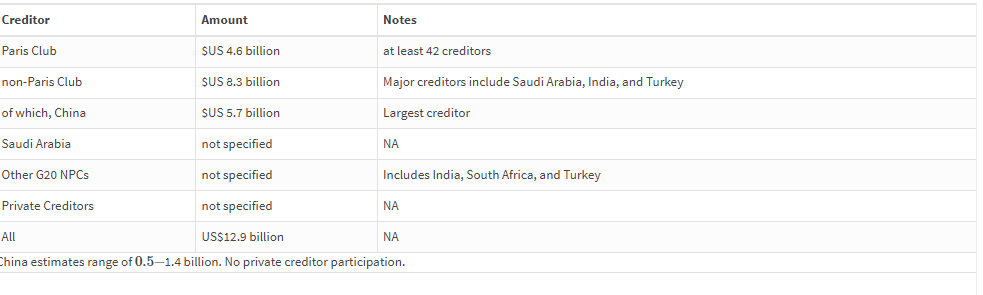
Table 1 sketches the DSSI’s history. The Initiative began in April, 2020 as part of the global package of COVID responses. The DSSI was conceived as a temporary suspension of debt service that was NPV neutral–it deferred payments but did not constitute relief of any part of the NPV of debt service due. Eligible debt included official bilateral and multilateral creditors, with some hope for private lender participation (though the latter did not happen). The initial DSSI ended in December 2021 with nearly 50 nations having received an estimated US$12.9 billion in debt service suspension. A press report, citing World Bank sources, claimed that the suspension was about 11% of expected debt service in the 21 month life of the initiative. Source: Yahoo Finance
Table 1: The Calendar of the DSSI/CF
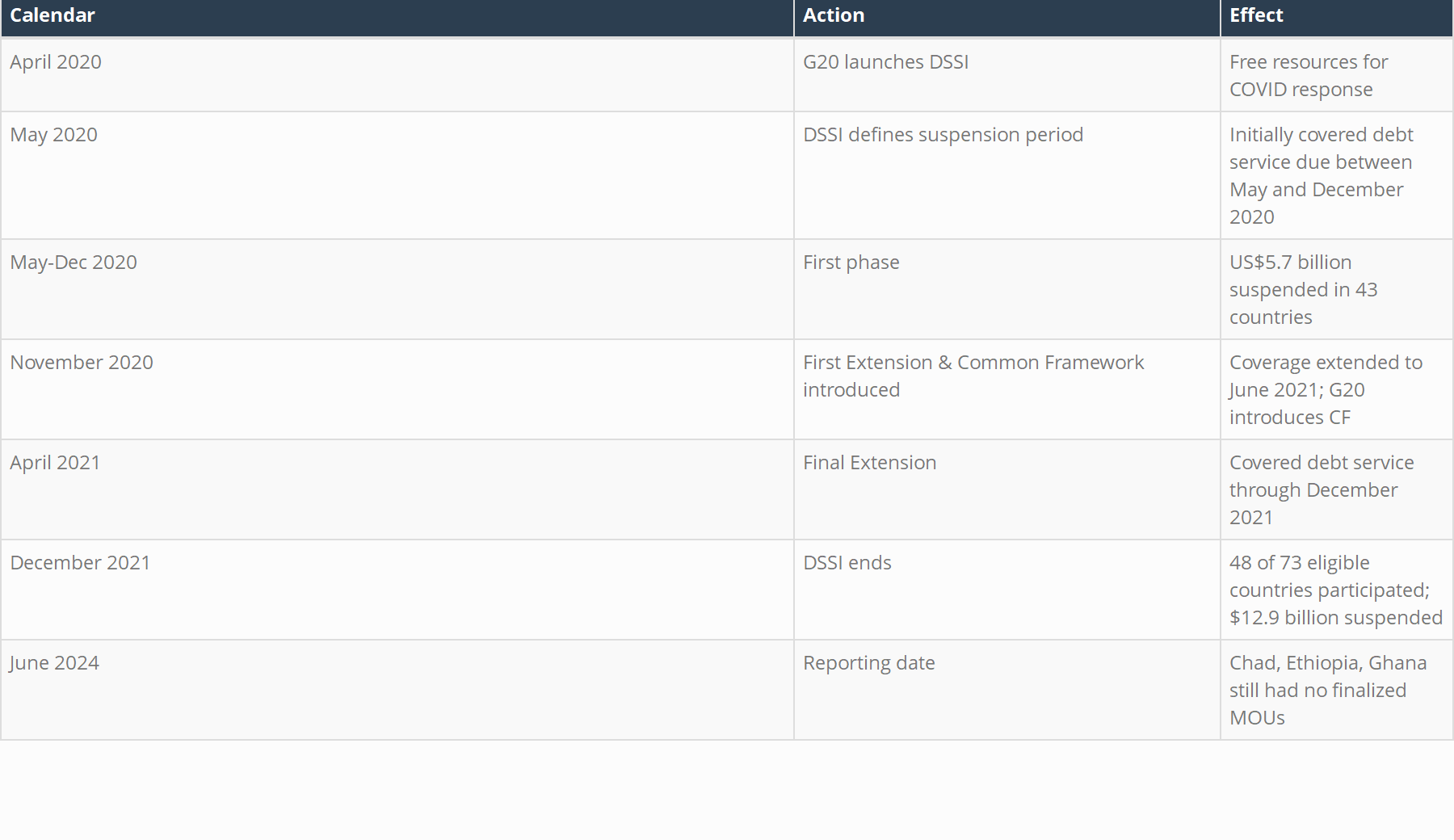
Table 2: Amounts suspended under the DSSI/CF
What has the Common Framework done ?
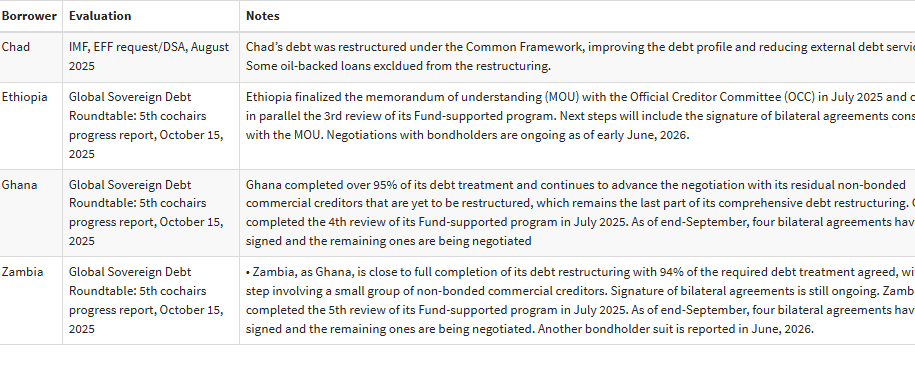
The Common Framework (CF) grew from the DSSI with the conveniently vague purpose of facilitating “timely and orderly debt treatment [for] eligible low-income countries”. Table 3 recounts official versions of the CF’s achievements to mid-2026 for the four CF countries–Chad, Ethiopa, Ghana, and Zambia. Sri Lanka and Suriname are not listed as CF cases, though one supposes they would be so listed had they been more successful. Table 3, constructed from information published by the Paris Club and the Brasilian Presidency of the G20, summarizes the status in October with updates to mid-2026 (link). It is fair to say that the debt treatment of a few eligible countries has not been timely.
Table 3: Common Framework outcomes to May, 2026
Why has the Common Framework failed ?
The CF has failed, first, because the Bank and the Fund defaulted on their monitoring responsibilities after the success of HIPC/MDRI some 20 years ago. Both institutions were warned about unsustainable borrowing in post-HIPC countries and looked the other way. The post-HIPC countries have gone on a borrowing spree, aided by the boom in Chinese finance and by the growth of private lending to countries that were previously blocked from credit markets.
There are other failures. The Chinese authorities are said to refuse to disclose their terms. The Bank and the Fund (and the other MDBs) reject a discount on their loans. Sri Lanka, Pakistan, and Kenya are making side deals. (There may be others). The CF has no way to compel lenders to participate nor to encourage borrowers to join, as did the HIPC Initiative.1
What now ?
What can be done to relieve the burden of debt on growth and public service provision in low-income countries after the collapse of the CF ? The many agreements under the Paris Club have only delayed solutions; while the Paris Club has to be part of a new solution, it is a small part. There will be talk of a new IMF mechanism – it is easier to speak about raising money than to propose more effective uses. The Fund, always easily manipulated by the large shareholders and their compatriots in commercial banking, will propose a mechanism to be wound by its own hands. (The Fund has forgetten that it did recently build a new model – the irresponsible expansion of COVID response lending with no oversight – which only worsened debt stress).
A recent proposal for more of the same comes from the US G20 Presidency, which issued a “template” for restructuring. The Atlantic Council reviewed the proposal (link) and argued that it might “do more harm than good, potentially worsening for both debtors and creditors.” My reading of the US G20 template is that it is not even a half-measure. It does not resolve the conflict betwee multilateral shareholders and the new bilaterals—the former do not want to subsidize the bad investments of the latter and the latter demand equal treatment with the multilaterals.
There is one way forward. The Bank and the Fund must accept a discount. I can already hear the piteous wailing from 19th street – a haircut will damage our capacity to make new commitments. So what ? Both institutions have made bad commitments for decades. Both failed to do anything about the worsening of the debt burden in the post-HIPC nations. They should bear some of the costs of the inevitable reckoning. How they can do so is the subject of the next post.
Cote d’Ivoire had been in default on its commercial debt for a decade or so by 1995 when Jim Wolfensohn became President of the World Bank. The Ivorians appealed to Wolfensohn for Bank assistance in restructuring their country’s debt. Wolfensohn told the lenders (and the Fund) that there would be no Bank assistance to the restructuring at a price greater than $0.25. And so it came to pass. ↩