How does the World Bank propose to rebuild Venezuela ?
“Whirl is king” — McGuane
The World Bank has published a Venezuela reconstruction report in record time[1]. It is a valuable report. The Bank’s team deserves credit, as do the official, scientific, and civil society organizations who contributed. The report nonetheless suffers from several fatal weaknesses, as I will show.
This post presents a brief analysis of the reconstruction paper, noting several omissions, notably any serious discussion of the country’s external debt. I argue that the Bank technical teams, and those of the other multilateral development banks (MDBs), confront deep conflicts of interest within the Bank (and the Fund) that have the potential to block the most effective uses of multilateral funding. The multilaterals also face extreme governance problems in Venezuela that will impede the policies and investments needed for reconstruction. Multilateral support must be crafted to solve those problems at the outset or the reconstruction will fail. I conclude by suggesting a compact to finance the initial reconstruction investments.
The damages
The Venezuela Global Rapid Post-Disaster Damage Estimation (GRADE) report defines economic damage as the costs of re-building housing, non-residential buildings, and infrastructure assets following the earthquakes of June 24.[2] Table 1 (derived from page 7 of the report) gives some details.
GRADE estimates (Executive Summary, p. 1: 2) total direct damage at US$19.6 billion; of which:
· Residential buildings: US$9.3 billion (47 percent of damage)
· Non-residential buildings: US$5.0 billion (26 percent)
· Infrastructure damage: US$5.2 billion (27 percent)
The authors note that many damaged buildings were made from “masonry, or reinforced concrete frames with masonry infill”. Accordingly, they conclude that their cost projections are under-estimates because they are based on replacement cost calculations of older structures which were not built to modern standards. Building to modern standards will be more expensive, implying that the US$19.6 billion is smaller than what will ultimately be necessary to rebuild the lost structures. Moreover, reported numbers of houses and other structures lost are probably under-counts.
Table 1. Reported impacts (derived from Venezuela GRADE report)
Human impacts. As of July 17, 2026, the number of deaths stood at 4,930, with 16,740 people injured. More than 128,000 families have received assistance UNICEF estimates that 1.8 million people, including 680,000 children, need humanitarian assistance. Before the earthquake, 7.9 million people were believed to need humanitarian support.
Housing. Mid-July official assessments report nearly 900 affected buildings; other assessments estimate the number to be in the thousands. Authorities have said that some 18,000 people are homeless.
Education. More than 900 schools across nine states are affected in an education system already operating under severe infrastructure constraints.
Health. Overall, 38 hospitals have been affected. Earthquakes affected a health system already operating under severe infrastructure constraints.
Transport. Damage to transport infrastructure has been reported across seven states, including major highways, bridges, and tunnels. The main international airport that serves Caracas remains closed to commercial flights and is receiving restricted humanitarian aid. The Port of La Guaira also remains closed with cargo diverted to other functioning ports in Venezuela.
Water, sanitation, and hygiene. Initially disrupted; restoration estimated > 85 percent by early July.
Power. Widespread outages, but 95 percent of national electricity demand was functioning by mid-July.
Telecommunications. Immediate outages, with recovery to > 75 percent functionality within 48 hours.
What reconstruction investments might do
GRADE used a WBG macroeconomic model to project how recovery investments would affect the economy (Executive Summary [ES], page 2). The model postulates that the earthquakes caused a one-time destruction of the capital stock, causing a loss of US$19.6 billion which is estimated to be 1.7 percent of the total capital stock. The quakes also caused a loss of labor supply equal to 1 percent of the labor force.
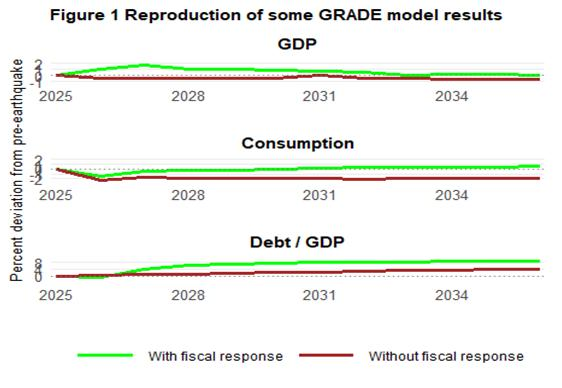
The model compares scenarios “without fiscal response” scenario to one “with fiscal response”. GRADE defines the without scenario as one in which GDP, investment, consumption, the fiscal balance, and the ratio of debt to GDP, fall slightly from pre-earthquake trends over the period 2026-2036. The trend scenario depends on the assumption of no rebuilding investment; the authors conclude that “in the absence of a fiscal response, productive capacity and economic activity remain suppressed over the 10-year forecast horizon” (p. 23) and GDP in 2036 is about 0.6 percent less than the pre-earthquake value.
The with scenario is one in which “… reconstruction is supported initially by increased public investment, to be gradually complemented by improvements in the enabling environment for private investment. In addition, fiscal transfers of US$500 million are put in place to support affected households in 2026 and 2027. Under this scenario, Venezuela mobilizes US$9.8 billion in additional financing to support the fiscal response, alongside US$9.6 billion in additional private investment over a five-year reconstruction period.” (p. 23).
The writers note that (ES, p. 2) “… the pace of reconstruction will play a decisive role in shaping economic and social impact. If public and private investment remain at their current levels [the scenario ”without fiscal response”], reconstruction would need to be financed by diverting resources away from other productive investments, and completion would likely lag beyond 10 years. Furthermore, productive capacity, GDP and consumption would all remain below pre-earthquake paths until at least 2036. These impacts can be mitigated by scaling up public and private investment to accelerate reconstruction [in the fiscal response scenario]”.
An alarming conclusion of the report (reproduced in Figure 1 here from Figure 8 in the GRADE report) is that without a strong fiscal response to the disaster, annual consumption would remain at a level 2 % less than the pre-earthquake baseline until 2036. With a strong fiscal response, on the other hand, consumption would recover to pre-earthquake levels by 2030 and would exceed those levels by about 0.5% annually from 2031 to 2036. The cumulative increase in consumption conditional on the with scenario over the pre-earthquake situation is -0.05 percent. The increase in consumption conditional on the with scenario compared to the without scenario is roughly 21.6 percent which, again, is too small even ignoring the fact that it is not expressed in per capita terms.
Observations on the model
The modeling (Section 4.3: “Macroeconomic impact”, p. 22, Figure 8) is poorly explained, a fact which prevents readers from verifying base parameters and scenario construction. Before anyone starts squeaking about “time pressure” (or “consultations” or “learning”), usw, readers may wish to note that the macromodel has been used for years [3] and that the Bank team had more than 20 members.
Listing a reduced form of the model would not have required much effort. Pre-earthquake (baseline) 2026 values for GDP, population, fiscal balance, shares of public and private investment in GDP; coefficients for (negative) earthquake shock multipliers and consumption-investment multipliers (which do not have to be too precise); and net foreign financing ranges to use in the two scenarios. Given the gaps in official Venezuelan data, the analysis would have had to use rough estimates of the baseline values, a reality about which the authors should have been more informative. Declaring the parameters would have clarified much, as would have publishing the complete code rather than listing a reference to an old paper.
The model scenarios are too limited. Two scenarios are modeled: (1) a trend (without fiscal response) compared to (2) rebuild “with fiscal response” using external financing of $19.6 billion in investments, of which about half would be public. There is a spurious precision here–no one knows what external financing really is because no one knows how much of Venezuela’s wealth is in New York or London or Geneva. No one knows what the inevitable debt restructuring will do to external debt service[4] and hence one cannot say with any confidence what incremental financing will be required to pay for restructuring. It would have been clearer to add a third scenario including a rough accounting of new debt service following a restructuring.
The without fiscal response scenario is not credible. By setting the without scenario at a low level (basically no change from the pre-earthquake baseline) GRADE has inflated the GDP and consumption effects of the with scenario. It is unreasonable to postulate that Venezuelans will do practically nothing to rebuild their country.
The with fiscal response scenario is too conservative. The Bank team has apparently been influenced by reviewers from the IMF, who generally insist on maximizing the primary surplus in order to repay obligations to the public and private financial institutions who control the Fund’s largest shareholders[5]. The with scenario barely increases national consumption over the period 2026-2026, as is shown in Figure 8. A change in total consumption of effectvely zero–not, mind you, per capita consumption–in the with scenario over 10 years ought to be completely unacceptable but this is that happens when you have political appointees running the institution as if it were a payday lender.
Targeting reconstruction to the most affected areas. The report states: ” … modeling conducted following the GRADE assessment shows that consumption impacts are uneven across social groups and may be higher among households with greater care and health needs or less secure forms of employment. Recovery measures may therefore be most effective when they combine physical reconstruction with continuity of essential services and targeted household support.” A program to rebuild housing, non-residential capital, and public infrastructure would have the advantage of being largely self-targeting because of the pattern of severe damage in poorer, densely-populated areas, but that does not excuse the modelers’ choice of making the with scenario too small.
Income transfers and distributional effects. GRADE describes affected residence and income groups (pp. 5, 23, 25) but does not incorporate group weights into either scenario. This is odd given that household survey data (p. 25) did allow an analysis of quake impacts on vulnerable groups and should therfore allow scenarios with distributional effects. The writers make the obvious point–“The findings indicate that disaster recovery may benefit from restoring and maintaining access to basic services. Service interruptions are especially consequential for vulnerable households and can even generate impacts in places where physical building damage is comparatively low.”–but they ought to have done more with the household data.
The report ignores environmental remediation. GRADE omits costs of environmental remediation. To be sure, the yanquis who now run the country do not care much about the environment, or about the serious health effects created by the quakes (oil and methane leaks, asbestos dust, small particulates), but one expects Bank staff to have been more assiduous (as they were on gender effects, at p. 29). A study of Turkey after a 2023 earthquake noted possible adverse long-term health consequences of dust exposure, notably pulmonary diseases. A Venezuelan press report noted environmental risks, notably dust and small particulates and potential disease outbreaks in temporary resettlements. Remediating environmental effects, notably those causing long-term health problems, will add substantially to reconstruction costs and should have been included in the rebuild scenario. [6].
Paying for rebuilding
GRADE is evasive on the origins and timing of its projected US$9.6 billion in private financing. Wholesale FDI is unlikely to arrive without guarantees from the reconstituted government or from foreign governments through their own guarantee agencies; both channels mean tied, costlier, procurement, thereby raising the costs of rebuilding. The report misses another aspect of private financing, which is the substantial arrears owed by the government to private (and public) companies. Arrears clearance is necessary to allow many firms to re-start or to expand operations and would increase the cost of the with scenario.
Public incentives for foreign direct investment. GRADE notes: “Complementary policy measures to unlock higher private investment would further support the pace of reconstruction”. This is fluff that the report should have avoided. We already see US and other foreign firms rushing to Venezuela after Maduro’s defenestration. It is likely that those firms will seek special fiscal incentives for their hypothetical investments. Such incentives pose a serious risk to Venezuela’s debt sustainability, even under favorable assumptions about what the country can achieve in a workout, and should be avoided. The Bank and the Fund should insist that special fiscal incentives not be given to foreign investors.
The report says nothing about barriers to potential remittances from the 8-10 million Venezuelans abroad. Remittances have the advantages of being self-targeting, of complementing sweat equity (e.g., in rebuilding private homes and businesses), and of not requiring public handouts as wholesale FDI promoters will surely demand. Remittances can, however, incur high fees while suffering from official harassment and one obvious policy to promote private investment in rebuilding will be to minimize fees and stop harassment of the recipients.
Another type of private financing is a digital currency where several forms are already known in Venezuela. One example is the Brazilian PIX, which is found in border cities. There are risks, notably in ordinary Venezuelans getting rolled by the US stablecoin issuers and in the yanqui crusade against PIX. Given the conflicts of interest within the US government and within Bank and Fund management, the advice of those institutions on a national digital currency or on further integration with PIX should not be considered as being in Venezuela’s interests.
The debt restructuring. GRADE’s largest omission is failure to say anything about Venezuela’s debt restructuring. A debt restructuring [7] Without a restructuring the looting of the country’s resources will continue, as we have seen with the disappearance of US$13 billion into an account controlled by the US administration. [8]. Even if there is a debt workout, no one can be sure that reconstruction money will not be diverted to the country’s foreign creditors and away from domestic spending.
A compact for immediate rebuilding
I propose a compact for immediate rebuilding needs, as outlined in Table 2. The compact would declare: (1) target amounts of concessional financing from multilateral and bilateral institutions; (2) priorities for global funding, following roughly those stated in the GRADE report (income transfers, housing, non-residential buildings, infrastructure); (3) immediate disbursement of income transfers to households without means testing; and (4) priorities for institutional roles, the MDBs, private business, and civil society organizations. [9]
Public financing of the compact. The World Bank and the IADB are the obvious candidates to lead reconstruction finance of about US$ 10 billion. Of that amount, US$ 4 billion should be put into digital currency accounts for Venezuelan households to allow unconditional cash transfers. The World Bank could endow US$ 2 billion, the IADB/CAF another US$ 1 billion and the IMF (from Venezuela’s SDR accounts) the final US$ 1 billion. GRADE suggests (p. 25) that World Bank support should be on non-concessional terms; this is unrealistic given the country’s wobbly debt service capacity and so the externally funded cash transfers should be on IDA terms. Another US$ 6 billion would be on IBRD terms to begin the reconstruction investments outlined in the GRADE report.
Table 2. An indicative compact to rebuild Venezuela
Cash transfers. Initial US$4 billion from public concessional sources
Residences. Initial US$5 billion from multilaterals on soft IBRD terms
Non-residential building. US$ 5 billion from multilaterals on soft IBRD terms
Water and sanitation. US $5 billion from utility bonds, other private, local market
Power. Unknown amounts from utility bonds, other private, local market
Telecommunications. Unknown amounts from private sources
Risks to a rebuilding program
The chief risk is the debt restructuring. It is inexcusable that the GRADE model excluded the fiscal cost of debt service after debt restructuring. Other risks involve the amount and timing of the workout. Venezuela is reported to have hired a US firm, Centerview, at a higher price than that at which it could have hired a French competitor. Why ? Maybe it is because Centerview can speak more directly to creditors (the US administration, interested Asian nations, the oil and gas companies, and the private financial institutions) about what debt restructuring is feasible, what can be grabbed recovered from the hidden assets, and how the burden of the workout will eventually be shared among Venezuela’s creditors.
The Bank will be squeezed to contribute to the debt restructuring through guarantees to private bank loans, as it has recently done to help Argentina pay the IMF. This is the sort of churning of the customer’s account that will appeal to WB President Banga and one imagines that the yanquis will know how to convince him to go along. Pressure on the Bank to lend directly to the debt restructuring, if it ever closes, should be resisted because it will limit what the Bank can contribute to the cash transfers that are needed immediately.
Any Bank follow-up to the GRADE report should show the assumptions about debt service after a restructuring and its opportunity costs in terms of foregone support to rebuilding.
Corruption. Other funds are at risk beyond the cash already seized by the yanquis. We do not know what Chavez/Maduro regime hid abroad. There is a risk of theft of reconstruction funds during the contracting for roads, water, sanitation, and power. One way of reducing corruption risks is to award all contracts competitively[10] There will be the usual self-interested complaints about competitive procedures from connected operators “private sector stakeholders” about how “the Bank is slow”, “the situation is urgent”, “people are starving”, but these complaints should be rejected if, as they probably will, they increase corruption in contracting.
The direct actions of civil society (in providing health, nutrition, and education services, for example) can mitigate some corruption. Because those actions are small, poorly funded, and always at risk of official capture or harassment, a reconstruction compact must ensure strict legal protection of civil society organizations and of their activities.
Conclusion
The Bank’s technical team has done well to prepare the GRADE report on short notice. The report’s mapping and preliminary quantification of quake damages are credible. The paper is the beginning of a reconstruction program. Nonetheless, the writers have evaded major problems, made poor modeling choices, and, as a result, have proposed policies that do not help as much as they could.
These shortcomings are the responsibility of Bank management which refuses to take its job seriously for fear of offending the largest shareholder while continuing to pretend that the institution should act like a commercial lender.
[1] World Bank. (2026). Global Rapid Post-Disaster Damage Estimation (GRADE) report: Venezuela Earthquakes – June 24, 2026. Washington, D.C.: World Bank Group. The report does not present its data or code.
[2] The report describes methods at: https://www.gfdrr.org/en/publication/global-rapid-post-disaster-damage-estimation-grade-approach
[3] From the footnote on p. 22, ”Results are based on the World Bank’s standard MFMOD macro-structural forecasting model, as documented in Burns, Andrew; Campagne, Benoit; Jooste, Charl; Stephan, David; Bui, Thi Thanh. 2019. The World Bank Macro-Fiscal Model Technical Description. Policy Research Working Paper;No. 8965”).
[4] Venezuela is reported to have appointed Centerview, a US advisor with red and blue connections, to do a debt sustainability analysis (DSA); that analysis was expected in early July but has not been made public if it has been completed at all.
[5] Venezuela has not had an IMF program for several years. It has no active World Bank-funded projects. I do not know what IADB and CAF are doing in the country.
[6] https://pmc.ncbi.nlm.nih.gov/articles/PMC12027378/) for Turkey; https://www.descifrado.com/2026/07/06/activistas-ambientales-piden-dar-uso-responsable-a-toneladas-de-escombros-derivadas-de-los-terremotos/#respond
[7] As I have outlined in https://johnmcintire.substack.com/p/what-do-the-imf-and-the-world-bank-6d8?r=lxiat
[8] A channel for funds transfer has been opened by US Executive Order 14373. The yanquis pretend that a well-known firm is auditing this account but until the audits are made public in real time, the claim is meaningless. Brookings has summarized a “Congressional Study Group on Foreign Relations and National Security” which was convened in February 2026 ” to discuss the legal question surrounding the Trump administration’s management of Venezuela’s oil revenue, sovereign debt, and economic rehabilitation, https://www.brookings.edu/articles/managing-venezuelas-oil-revenue-sovereign-debt-and-economic-rehabilitation/
[9] The IMF’s contribution should be limited to paying the upfront costs in a debt restructuring.
[10] One expects the new Bank director for Venezuela to put the renowned experience of his home country to good use in stopping corruption from damaging the rebuild.