Some MAGAts dont need to be paid
Seventeen months ago, I argued [1] that the Trump regime would let tariffs, spending cuts, and changes in institutions, regulations, and laws, as planned under Project 2025, fall wherever they happened. The regime’s planners gave little initial thought to distributional effects, probably assuming that their cultural base was strong enough to withstand some shocks. However, because some cadres of the regime understood many MAGA voters would see the reality of Project 2025-- it harms their economic interests--official Trumpism would decide to overcompensate red constituencies, economically and culturally, to avoid losing votes. Economic compensation would be accompanied by agitprop from state TV and social media, and by show trials of spiders (Dr Fauci, Ivy Presidents, Jack Smith, reporters) to solidify that form of cult loyalty that does not demand cash.
My general argument reduced to an African proverb—“Feed a dog and he stops barking”. I made fifteen specific Predictions about how the compensation would be engineered and targeted to the red states, as summarized in Table 1. This post grades those predictions in the context of Trump’s net approvals among Republican and “independent” voters.
Confirmed predictions
Prediction 1 —that the regime would use “obscure rules in budget reconciliation to overpay the red states for the harm that policy has caused them and to underpay blue states for the harm they have suffered”—initially gave mixed results. The OBBBA (signed July 4, 2025) contained red-shifted provisions — clean-energy clawbacks that hit blue-state climate programs harder, and a Foundation for Government Accountability push to “hold blue states accountable” on social protection enforcement (FGA, April 6, 2026). The bill’s Medicaid cuts (roughly $793–911 billion over ten years) hit expansion states broadly, and an independent analysis found the steepest percentage cuts falling on Louisiana, Illinois, Nevada, and Oregon — a red/blue mix — while the Medicare Rights Center listed red states like Kentucky, Ohio, Oklahoma, and Missouri among the hardest hit (KFF, July 23, 2025). West Virginia alone could owe some $27 million more under new SNAP cost-sharing rules (Raw Story, July 6, 2026). The mechanism of executive orders tilting Medicaid against blue states is real— the deferral of CMD funding to Minnesota is an example— but the dominant cuts did not spare red states or rural areas in general.
We see stronger confirmation of this prediction in the NYT (July 22, 2026). Following recent public disclosure of proceedings in a lawsuit filed by University of California scientists in June 2025, we now know that regime gauleiters cancelled Department of Energy (DoE) grants to entities in places having voted for Kamala Harris and maintained grants to entities in places having voted for Trump. The NYT quoted a regime ambulance chaser “DOE lawyer” as admitting that there were no substantive grounds to cancel the grants to blue states. My prediction holds under the fact that money is fungible—the regime cancelled blue state grants and reallocated the savings to farm subsidies and incremental military spending in red states.
A March 2025 postscript to my original February 2025 post noted that the $1.44 billion DoE loan for Montana’s sustainable-aviation-fuel refinery — a Biden-era IRA project —was the first loan the administration unfroze. Senator Daines (MAGA-MT) took credit for it within days. I do not have a clean answer on whether the labor-standards conditions were waived, so that piece stays open too.
Prediction 2—that there would be a fake-fraud campaign against Social Security and Medicare—is confirmed in an actual White House release called “Full-Scale War on Fraud” and a CMS branding exercise literally named “CRUSH Fraud”. CMS deferred $259.5 million in Minnesota’s Medicaid match over “unsupported or potentially fraudulent” claims in February 2026. One detail I cannot confirm is the targeting of women providers and providers of color — that prediction stays open.
Prediction 4—that Medicaid cuts would be targeted to blue states—is a mix. An independent analysis (KFF, https://www.kff.org/uninsured/how-will-the-2025-reconciliation-law-affect-the-uninsured-rate-in-each-state/, accessed July 24, 2026) found that the OBBBA would raise rates of uninsured people by at least 3 percentage points in 20 states and the District of Columbia, with most of the states being blue. The mixed pattern of the cuts is a feature of Medicaid whereby rural populations are more likely to vote red and to receive Medicaid in the first place.
Prediction 6—more untied farm subsidies to red states—is confirmed. Trump announced a $12 billion farmer bailout in December 2025, explicitly to offset trade-war damage, with no behavioral strings attached and payments capped by farm size. The regime came back for another $11 billion in June, bringing its cumulative farm aid across two terms (2017-2020; January 20, 2025-present) to roughly $50 billion. NPR reported plainly that was designed to “shore up the president’s relationships with a group that had been part of his base ahead of November [2026] elections”. People like briefly famous Missouri farmer-TikToker Skylar Holden got paid, in other words.
Prediction 7—FEMA money would be channeled to red states to Texas and Florida and away from California — is confirmed. A disaster-policy tracker [2] found the administration approving 89% of red-state disaster requests against 23% of blue-state ones in the first fourteen months, with Republican states waiting 39 days on average for approval and Democratic ones waiting 80. Hazard-mitigation grants to Democratic states went from roughly $91 million a month to $3 million; California has gotten $830,000 in aid since last July while Colorado got nothing.
Prediction 11—the NDA and whistleblower crackdown—is confirmed. A leak crackdown with mandatory polygraphs was pushed on DHS, DOJ, and DoD. In May 2026, OPM proposed a rule requiring federal employees to sign NDAs. While I did not mention mass pardons as the other side of whistleblower crackdowns, they are clearly a tool for buying silence just as NDAs are a tool for imposing it.
Prediction 12—USAID as cultural prop—is accurate. The agency closed on July 1, 2025. The $57,000 Sri Lanka line — Karoline Leavitt cited it at a February 2025 briefing — turns out to be a real talking point that fact-checkers and procurement lawyers said did not meet the legal definition of fraud at all, just an item of discretionary spending.
Prediction 14 — blaming immigrants for disease outbreaks — happened almost exactly as written when RFK Jr. blamed measles, polio, and TB on immigrants during the worst US measles year in three decades. I cannot find the funding-blockade linkage I predicted, and on avian flu specifically, researchers argued the immigration crackdown scared migrant farm workers away from testing and made containment worse — the opposite of the narrative I expected.
Prediction 15—fossil-fuel-as-manliness holds on substance — the drilling expansion, the offshore wind freeze, the OBBBA killing wind and solar credits, and 216 cancelled clean-energy projects and something like 468,000 lost jobs by an E2 count — though the literal gendered framing shows up more in critical academic writing about “petro-masculinity” than as an actual White House talking point.
Failed predictions
Prediction 3 was wrong. I predicted the administration would maintain the SALT cap to continue squeezing high-tax blue states. Instead, the reconciliation bill raised the SALT exemption from $10,000 $40,00, which is a small measure of compensation to blue states for supporting red-state welfare for decades. Apparently, the House majority needed blue-state Republican votes more than it needed to punish blue-state taxpayers.
Prediction 9 is a mix. I predicted funding conditions built around abortion and gun laws. The regime’s camp followers in Congress have attempted to push through more restrictions on women’s rights, though these attempts have generally been blocked by the Democratic Congressional minorities and in the courts. What happened was a Department of Education dismantlement order, a national private-school tax credit tucked into the reconciliation bill, and roughly $65 million withheld from New York City, Chicago, and Fairfax County, Virigina, over DEI and transgender-athlete policy rather than abortion or open carry. SCOTUS having done what it was told on women’s health, enforcement of the regime’s campaign against women has been sub-contracted to the Confederate states where principled opposition is more easily overcome or doesn’t exist at all.
Prediction 10—that research money stolen from blue institutions would be given to red ones—is a mix. I got the credit-taking right and the money flowed backwards. I assumed NIH, USDA, and DOE money was being siphoned from Berkeley, MIT, and NYU into UT, Purdue, UAB, and UF. A Center for American Progress accounting of over 4,000 terminated or threatened grants found red and blue states hit in roughly similar proportion relative to student population — and Texas, not Massachusetts or California, was the single largest loser in dollar terms. The play-acting around these grants did not change. Katie Britt bragged about US$28.6 million for George Wallace’s state after hosting the NIH director at UAB. I could not find soon-to-be-Baylor-President John Cornyn doing the same for research money in Texas—his headline 2025 number was about VA and IRS service fixes.
Prediction 13 — expansion of the surveillance state and the bounty economy — is a mix. The supposed $750 bounty per ICE “tip” seems to be an urban legend. It is not clear what links exist between the feds and surveillance camera operators. ICE has awarded money to bounty hunter forms and the private prison business has grown along with the surveillance apparatuses.
Did compensation work ?
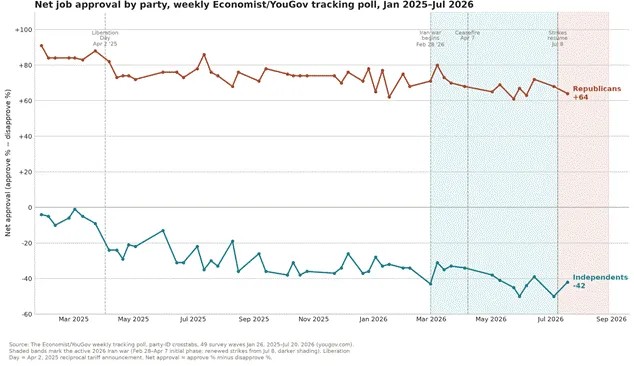
The purpose of “cut-widely-and-mend-narrowly” — keeping red constituencies from voting blue or from abstaining in November 2026 —has partly been achieved in terms of polling numbers. Figure 1, giving net Trump approvals for Republicans and “independents” during his second term, shows that the net Republican shift has been small compared to the net independent shift. [3] These numbers are not votes, and do not even reflect intentions to vote, but they suggest erosion of cult beliefs among “independents” with smaller losses among self-declared Republicans. After March 1, 2026, there seems to be a negative effect on approval of the regime’s lies about the Iran war among both Republicans and independents.
Rural approval of Trump has gone from +22 to −10 in NPR/PBS/Marist polling. Democrats are running somewhere between six and eleven points ahead on the generic congressional ballot depending on the pollster (the averages run a bit lower). A POLITICO analysis of 229 special elections since the inauguration found Democrats overperforming Harris’s 2024 numbers in 193 of them — a steeper shift than the 2018 wave that cost Republicans 41 seats. Prediction markets put Democratic House control at 84 to 87% and Democratic Senate control at about 45 %, with full Democratic control at 43-38 %.
None of this proves or disproves my compensation thesis. No poll I’ve found isolates tariff or subsidy specifically as drivers of sentiment, as opposed to inflation, health-care costs, or plain accumulated disapproval. The simplest version of these predictions — that compensation to some red-state voters would be sufficient to keep them red — is confirmed for self-declared Republicans but not for self-declared independents, as we can see in data extracted from Figure 1 in the following table[4].
Some explanation, however, is offered by what I am calling the Quiggin-Gelman (Q-G) model of Republican support. The model implies that some Republican support is inelastic to compensation because, in Quiggin’s words, the US has a “default identity politics” in which “white, Christian, men” consider it their birthright to run the country. That form of identify politics holds across income levels and, to a lesser extent, across education levels. These people wont refuse a hand-out, but one is not strictly necessary to gain their vote. Another part of the Q-G model is Republican voters with higher income and higher education. Their support, especially in the form of campaign donations, is more elastic to compensation. Such groups would include wealthier farmers and those benefitting from higher SALT exemptions and they will never hesitate to demand compensation.
Compensation to “independent” voters seems not to have helped the Trump regime in holding on to their approval but “we’ll see what happens” with them in November as the full effects of gerrymandering and vote suppression became clear.
Table 1
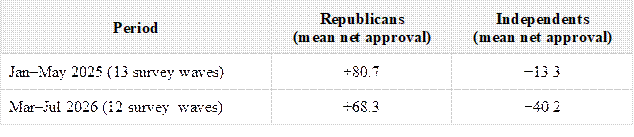
Figure 1
Footnotes
[1] John McIntire, The Apricot Tree of Tangiers, “If you want a dog to stop barking give it something to eat”, https://johnmcintire.substack.com/p/if-you-want-a-dog-to-stop-barking, February 15, 2025. The original remark is attributed to Paul Biya, forty-five years as President of Cameroon and doesn’t look a day under 90.
[2] “Trump Is More Likely to Reject Major Disaster Declaration Requests from Democratic Governors”, https://therevolvingdoorproject.org/trump-disaster-policy-tracker-map/, accessed July 23, 2026.
[3] I tend to believe that self-described “independents” are liars (that is, Republicans who don’t want to admit what they are) or lazy (“I don’t pay much attention to politics”) or confused (“Keep your government hands off my Medicare !”).
[4] Polling data from the first 18 months of Trump’s first term (1/2017-7/2018) show no fall in support among Republicans and only a slight fall among independents.
[5] Described by John Quiggin in his Substack of July 24, 2026: “Nate Silver discovers the educated poor”, with data acknowledgement to Andrew Gelman.