What do the IMF and the World Bank owe Venezuela ?
2026-07-04
Introduction
Commentary is growing on the legal, procedural, and political aspects of restructuring Venezuela’s external debt1. That commentary works in something of an artistic void on the economic aspects, of which much is said and little is known. The FT reports (June 24, 2026) estimates of Venezuela’s stock of external debt of the order of US$240 billion; previous guesses had been US$150-US$170 billion. No one knows much about the ratios of debt stocks to GDP, or of debt service to exports or public revenue. No one knows much about its economy in general.
I write here not because I have any private information about Venezuela’s debt or how to relieve its burden.2 I write because Venezuela is another test of the viability of two major global institutions, the World Bank and the IMF. The Bank is failing3 because two decades of bad leadership have made it into a costlier version of the UN, with an abandonment of project quality in favor of an ever-greater volume of pay-day loans to insolvent borrowers. The Fund is failing because its principal shareholders treat it as a sort of crypto account for moving cash among favored clients, as we see today in Argentina, Egypt, Pakistan, Senegal, Zambia, Nigeria, and others, and because it does nothing about corruption in the use of its resources.4
It is not my purpose to review existing guesses about the country’s debt, except to say that it is large enough to stimulate predation among current and prospective creditors. The question is not whether there will be a restructuring of the debt. There will be a restructuring. The question is—how much of the benefits will be looted by avaricious creditors and their agents who will manipulate any deal in league with Venezuela’s leaders. The opacity of Venezuela’s obligations and the malignant greed of many involved create the risk that a furtive workout will further ruin the country. Even getting a relatively straightforward Venezuela deal will be unusually fractious because the US, other national interests, and private claimants will push the IMF and the World Bank to intervene on behalf of creditors to avoid squalid arguments in the courts. These realities put heavy responsibility on the IMF and on the World Bank, as theoretically independent agents, to defend the interests of the citizens of a member country against external predators and even against their own rulers. Current leaders at the Fund and the Bank are not meeting those responsibilities.
This post: (1) makes some guesses about the size and composition of Venezuela’s external debt stocks; (2) models a hypothetical exchange between new bonds and about 80% of the old obligations; (3) calculates how debt service under the hypothetical exchange compare to guesses about oil export income; (4) proposes an IMF role in the hypothetical exchange; (5) recommends a job for the World Bank in reconstruction investments that must accompany any restructuring; and (6) identifies risks to the deeply-compromised integrity of the IMF and the World Bank arising from their potential programs in Venezuela, notably how some Bank roles would conflict with its development mandate.
Readers will note that emergency relief and reconstruction, following the earthquakes of June 23, are obvious tasks for the World Bank and the regional development banks. Arguments about the country’s macro-framework must not delay such assistance. Nor should appeals ad misericordiam encourage Venezuela’s partners to waste support on rotten investments in the name of urgency.
How much to restructure?
Four classes of creditors hold Venezuela’s foreign debt: international bondholders, bilaterals, multilateral development banks, and a catch-all of “unidentified”. The ‘Upper bound’ column in Table 1 is a rough measure of maximum potential claims. I work downwards from the US$ 240 billion of the upper bound.
Venezuela can pay multilateral arrears of about US$4 B from its own resources, including gold blocked in the Bank of England and assets of the national oil company, PDVSA, in the US.5 A quick settlement of Venezuelan arrears to the IADB could allow new loans from the IADB for earthquake relief without dealing immediately with the World Bank and the IMF. Setting aside another US$36 billion in “holdouts” (as shown in Table 1) allows us to work from a first block of claims of $200 billion—$60 billion from bondholders, $60 billion from bilaterals, and $80 billion unidentified. Let us consider that sum before looking at the more litigious holdout category.
The US$ 80 billion in what I term “unidentified” within the $200 billion will cause a battle. The leap from the range of US$150-170 billion to the early July headline of $240 billion is perhaps the first skirmish in that battle, resulting as it probably did from unidentified creditors exaggerating their claims (delayed interest, penalties, fees, usw). Venezuela has hired a US firm, Centerview, to advise on its workout, a wise choice given that the firm has both red and blue connections. One assumes Centerview will look sharply at some claims with the intent of excluding them from an eventual deal. Some creditors, shy of inconvenient publicity, may be less aggressive than others in seeking repayment and their claims might therefore be more cheaply settled. Supposing that Venezuela’s and its advisors can exclude some submissions, one may imagine that three-quarters of the $80 billion can be made to vanish, leaving the workout at $140 billion (60 + 60 + (1−.75) × 80). This is of course an optimistic assumption. If only half of the $80 billion can be excluded, the initial workout perimeter would be $160 billion (60 + 60 + (1−.5) × 80) rather than $140 billion, requiring a larger haircut or longer amortization of any new instruments.
There is a second block of creditors—arbitration claimants, PDVSA bondholders, and distressed debt investors—waiting for as much as US$ 36 billion. Among the $36B in claims that might remain outside a general workout are: Arbitration claimants (upper bound of US$19 billion) with upheld awards who are likely to litigate; PDVSA bondholders may claim as much as US$7 billion and have collateral. Distressed debt investors, holding perhaps US$10 billion, might settle at a small discount.
The holdouts have the privilege of litigating in their home country and some have court judgments already rendered in their favor. Some litigants would seem to have the pugnacious temperaments described in Gregory Makoff’s saga of Argentina’s workout (”Default”) and would not accept a sucker’s share lightly. The Centerview people are possibly well-acquainted with the claimants of the $36 billion and this relation might affect the overall deal. Another reason to exclude the holdouts from a hypothetical general restructuring is that their paper may not be covered fully by collective action clauses, without which one may expect further litigation delays. Let us allow that on-going litigation and judgments in place will make the holdouts unwilling to be part of a general workout, that Venezuela will get only a small discount on the potential US$36 billion, and, to paraphrase what someone once said of an obligation to Howard Hughes: “may they take it all in pennies”.
A hypothetical restructuring
A “return to the market” is the wrong objective. I should define the objective of a hypothetical restructuring before saying how it might work. Restructurings often have a stated objective of allowing an insolvent country to “return to the market”. This means — “once most claimants have been paid to drop their lawsuits, foreign borrowing can begin again”. This was a goal of the 1994-96 Mexico workout, to cite one example, and of many other restructurings. A “return to the market” will be a public objective of a Venezuela restructuring but must not be a prominent one (despite the inevitable quiquiriqui from the Bank and the Fund). The country does not require more expensive and corrupt external commercial borrowing because it can finance increases in oil and minerals output from the investments of the producers. It can finance non-oil investments in public services and public infrastructure by borrowing from the development banks. Ordinary commercial and private lending (e.g., housing finance) can be done in local financial institutions.
The proper objective of the restructuring should be to make oil investments dependent only on the costs of such investments and on world prices, while putting the costs of new commercial borrowing on the oil companies, not on the host country.6 A second objective should be to limit official borrowing in the central government and in the departments and municipalities to investments in public goods—non-oil infrastructure, social services, and environmental restoration.
Table 2 sketches a hypothetical workout in which the IMF lends the up-front payment of US$ 20 billion on softened terms. The softened terms assumed here (1% SDR rate, no margin, no surcharge), which are typically reserved for low-income countries, reduce obligations to the IMF by about 11.5 percent, saving some US$ 2.73 billion in debt service when compared to harder terms. Venezuela does not automatically qualify for softer terms, but the new regime does have friends in the IMF to make its case.
The hypothetical amount to exchange is US$70 billion, derived from the perimeter of US$200 billion minus US$60 billion of exclusions leaving US$140 billion and then applying a haircut of 50 percent on that balance. The exchange creditors would surrender their claims and receive US$20 billion (via the IMF) at closing plus exchange bonds with a face value of US$50 billion bearing interest at 7.5% over 10 years.7 Given the parameters in Table 2, the expected IRR to the exchange creditors would be about 12.5 percent. From the creditors’ point of view, this hypothetical arrangement is arguably: (1) comprehensive, given what is public about Venezuela’s liabilities; (2) transparent8; and (3) capable of offering a respectable return.
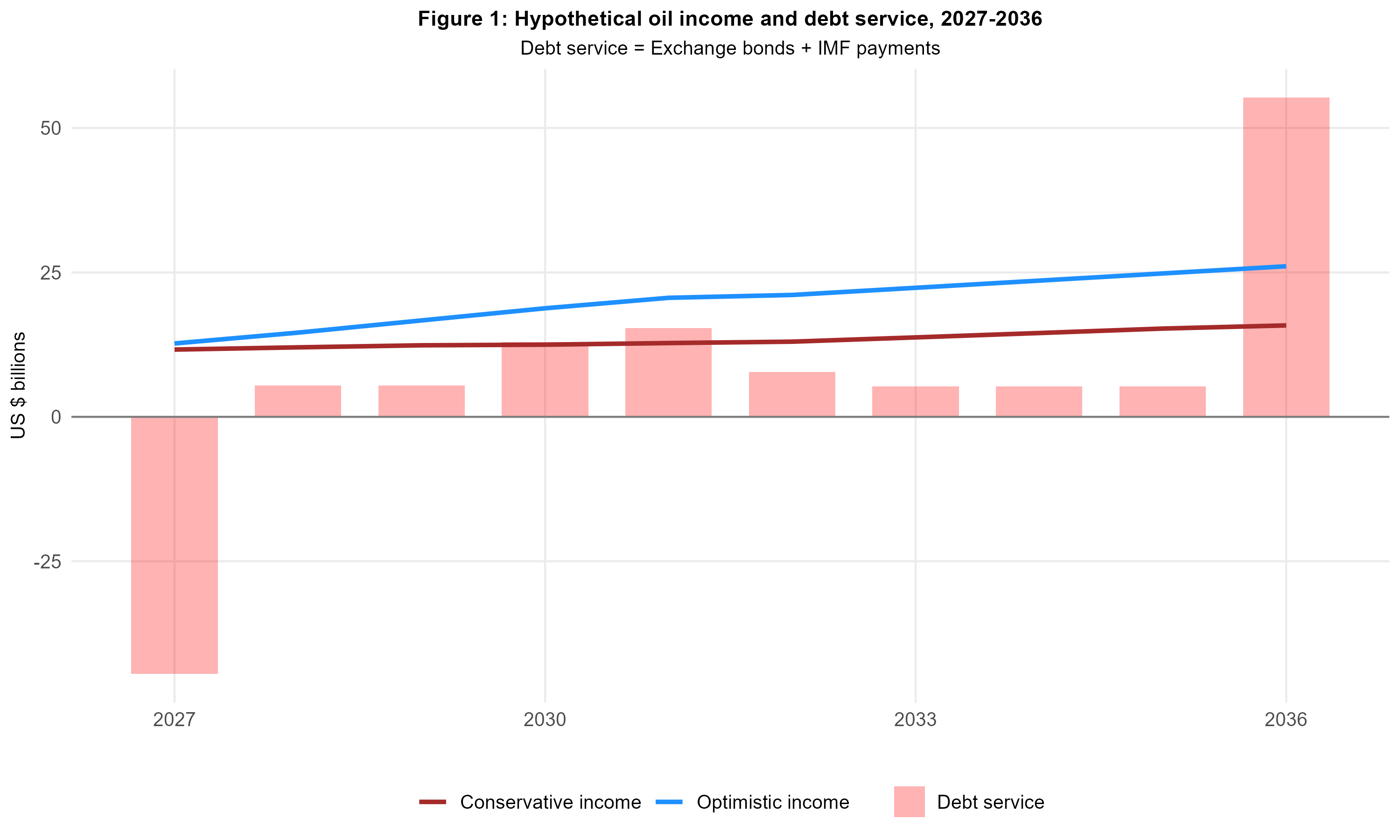
The hypothetical deal is a mix for Venezuela. The country would receive comprehensive treatment of five-sixths of the estimated $240 billion, renewed access to official multilateral lending, clarity about the remaining amounts to re-structure (so that obligations arising from ongoing litigation are circumscribed), and “a respectable return to creditors” allowing Bretton Woods flacks to make happy talk about Venezuela being “open for business”. This hypothetical exchange might, however, be unattractive over the next 10 years because potential oil income could at times be little more than hypothetical debt service, as I discuss next.
Potential oil export income and its relation to debt service
Table 3 reports some guesses about potential oil exports. The table constructs two scenarios (“Conservative” and “Optimistic”, in which average output varies between 1.2 mbpd and 1.6 mbpd over 10 years. Net oil income varies between 12 US$ billion and 26 US$ billion.
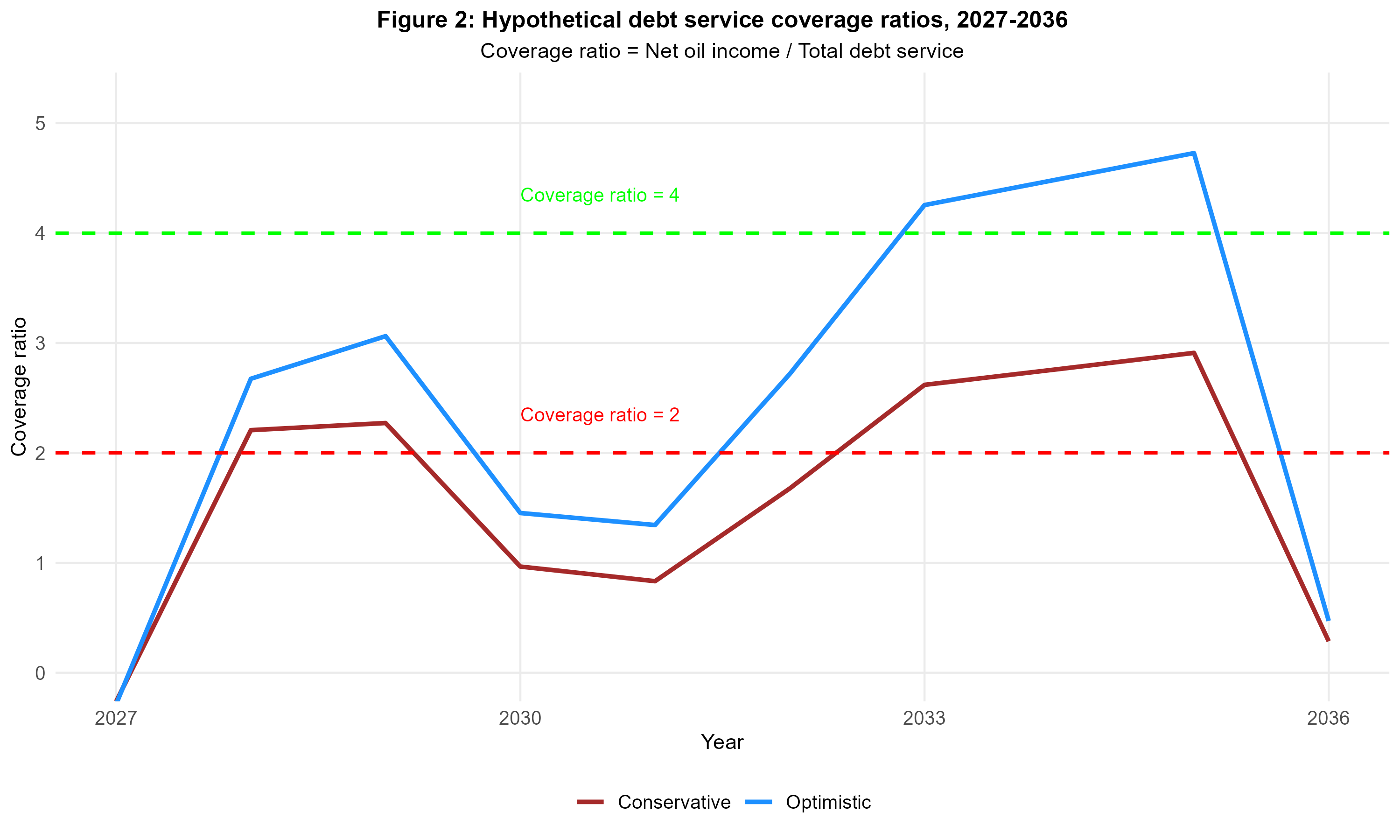
How do these guesses compare to projected service of the hypothetical exchange bonds and potential IMF loan? Figure 1 gives the raw numbers for oil income and for debt service (to the exchange bondholders and to the IMF). Figure 2 gives debt service ratios derived from the raw numbers. Even allowing for a substantial reduction in debt service under the terms of the exchange, Venezuela’s debt profile would not be considered sustainable in most years under conservative projections about future oil income. The costs of the hypothetical workout should therefore be considered as an upper bound, given what they imply for the country’s debt service capacity, and ought to be negotiated downward.
The role of the IMF
The IMF has a key role in achieving fair terms for Venezuelan citizens in a restructuring. An unknown in this hypothetical workout is how much can be recovered from what Venezuelan regimes have looted. Venezuela’s consultants will not worry much about this, but the IMF and other multilaterals should. Fund staff—if their managers and Board members let them work—can potentially ensure better recovery of stolen assets by insisting on transparency in the workout.9 I write “potentially” because the Fund’s recent record of transparency in Argentina, Ethiopia, Senegal, and Zambia, to name a few, is bad. The gap between the lower bound to restructure (US$ 107 billion) and the upper bound (US$ 240 billion) is due to uncertainty, may I say, about how much can be recovered from stolen assets. Any Fund support to the up-front payment, without which a restructuring is unlikely, must come with an accounting of what has been looted.
The IMF is essential to closing the restructuring. The Fund is going to put cash up-front, without which the deal will be practically impossible to close.10 One advantage of Venezuela not having dealt with the Fund for two decades is that the country owes nothing to that institution, unlike such other distressed accounts as Argentina, Egypt, Pakistan, and Côte d’Ivoire. The country therefore has resources in the Fund against which it can borrow. Venezuela could by my estimate draw perhaps $20 billion against its Fund quota, money that can be used for an initial payment to the creditors involved in a hypothetical restructuring.
One trivial obstacle to a Fund role will be mewling from moth-eaten Melcher Commission types that “hard-earned tax-payer dollars from the IMF and the World Bank are going to pay Chinese banks”. This is untrue, but the task of refuting nonsense does require the multilaterals to explain themselves better. We see the IMF’s inability in that regard in a May 2026 press conference. [link] Fund flack Julie Kozack got several Venezuela questions: How would the Fund engage? Would there be a program? Would the Fund be involved in a debt restructuring or a debt sustainability analysis (DSA)? Kozack answered that a member country must request a program, which sounds reasonable unless one knows that the Fund often squeezes members to make such a request.
Kozack continued that the Fund does not participate in discussions of debt restructuring. This is plainly dishonest (Kozack, whose LinkedIn profile says that she “oversaw the IMF’s work on Argentina”, clearly knows better). The Fund participates in restructurings by setting the fiscal parameters that define a member’s debt service capacity; no DSA is possible without those parameters because IMF support is unavailable without a macro-framework that Fund staff can sell to their Board. Venezuela cannot emerge from default without making cash concessions to the claimants. It cannot finance such concessions without Fund assistance. It is characteristic of official Fund utterances that those making them seem unaware that their institution can be shown to be doing the right thing; absent this vision, its managers are left to make misleading statements.
What if Venezuela goes it alone? Martin Torres, who, as a former Argentine representative in the IMF, knows the territory, wrote in the FT (June 29) [link] that Venezuela is considering restructuring without the IMF.11 Torres observes that “Argentina’s experience suggests that this is unlikely to succeed.” He is right. I also think it unwise for Venezuela to go it alone, but then I don’t know what the regime knows. What the regime might know is: (1) the assets held abroad; (2) the discreet assistance available from certain friends, notably in the exploitation of gold and other minerals; (3) the possibilities of side deals with creditors eager to cash out; and (4) the volume of Venezuela’s oil that has already been sold.12 Hidden assets would make the regime reluctant to open its books to the IMF and to the creditors. Using hidden assets to make private deals would of course prolong litigation (because the holdouts will be prepared for this attack on their interests), but the regime is perhaps calculating that the costs of litigating are less than the benefits of protecting hidden assets. “Going it alone” means, in sum, that the regime will craft a partial deal by setting one group of creditors against another while hoping oil and mineral production grows after the lifting of US sanctions.
“Going it alone” would have implications for an eventual World Bank program.
What the World Bank must not do
The Bank should have no direct role in the workout. A direct role would conflict with the Bank’s real job, which is to create development impact. A Bank contribution to the upfront payment, which has been done in IDA countries, would have an opportunity cost in Bank support to Venezuela’s reconstruction. The Bank can instead invest in physical infrastructure, in environmental remediation at the oil sites (where the needs are large and where the workout partners have no conscience whatsoever), and in investments in the municipalities. The Bank faces here the usual questions about working with rotten governments — how much sovereignty will those governments surrender to allow greater civil society participation in project design and management ? How much trust can the Bank put in civil society, business, and research, entities which might assume some of the sovereign’s jobs, given the possibility that such entities are manipulated by the government ? The quality of the restructuring will give some answers. A realistic, transparent deal that recognizes Venezuela’s debt service capacity and its investment needs will be an indicator of the trust that the country’s international partners can place in the current regime.
The Bank must not give guarantees to financial instruments or indulge in other financial engineering. One possible guarantee in a package with the bond exchange is one in which the Bank would insure a return to the exchange holders. Given the general unreliability of the borrower, and the bulimia of its creditors, the Bank should not guarantee the returns to financial assets.13 Another dangerous form of financial engineering would be a value recovery arrangement (VRA) in which the Bank would underwrite recovery of some of the original haircut during the term of the exchange. A VRA should be avoided given that it, again, gives too much to exchange holders who have already made a good return (at least as far as I have modeled it here).
Unfortunately, internal incentives might push the institution into guaranteeing returns to the exchange bondholders. Ajay Banga only knows financial engineering and he has shown no interest in the quality of the Bank’s portfolio. Many exchange holders have deep connections in the Bank’s Board. Some staff will view flogging “financial innovations” in a conflict country as a path to advancement. Churning of Venezuela’s account via some obscure financial manipulations would be nothing more than a transfer of risk from the exchange holders to the Bank. The institution should avoid such manipulations.
What the Bank should do
After immediate settlement of arrears to the IADB and the CAF: An immediate settlement of official multilateral arrears could allow fast-disbursing IADB budget support for earthquake recovery, while allowing the Bank to participate in technical work with the IADB and the CAF to survey reconstruction needs.
The Bank should lead a consortium investing in public infrastructure, following the initial survey. Investments in earthquake recovery and environmental remediation, power, water, transport, health, and education should be made in that sequence.
The World Bank program should have two parts. The first part should be IBRD budget support for earthquake reconstruction and priority environmental cleanup in the oil-producing areas. This should be done with a minimum of conditionality and with a serious effort to geolocate all works financed under this part.
The second part should be IDA (concessional) support to the 23 departments and the more than 300 municipalities.14 The Bank should lend on IDA terms directly to the larger departments. To assist sub-national governments, IDA could lend to the central government, which would make block grants (not loans) to the less-populous departments and cities.
What if Venezuela goes alone on debt restructuring without financial or technical assistance from the IMF? If Venezuela goes it alone without the support of the Fund, then the Bank should judge the results on their merits—does a solo deal provide adequate debt relief compared to the country’s export and fiscal prospects? Is it transparent on comparability of treatment, on recovery of stolen assets, and on access to national oil and minieral resources ? Absent such transparency, the Bank’s participation in reconstruction finance must be limited.
I conclude with the obvious point that the Bank must not get involved in any Gaza-type Board of Peace jamboree in Venezuela.
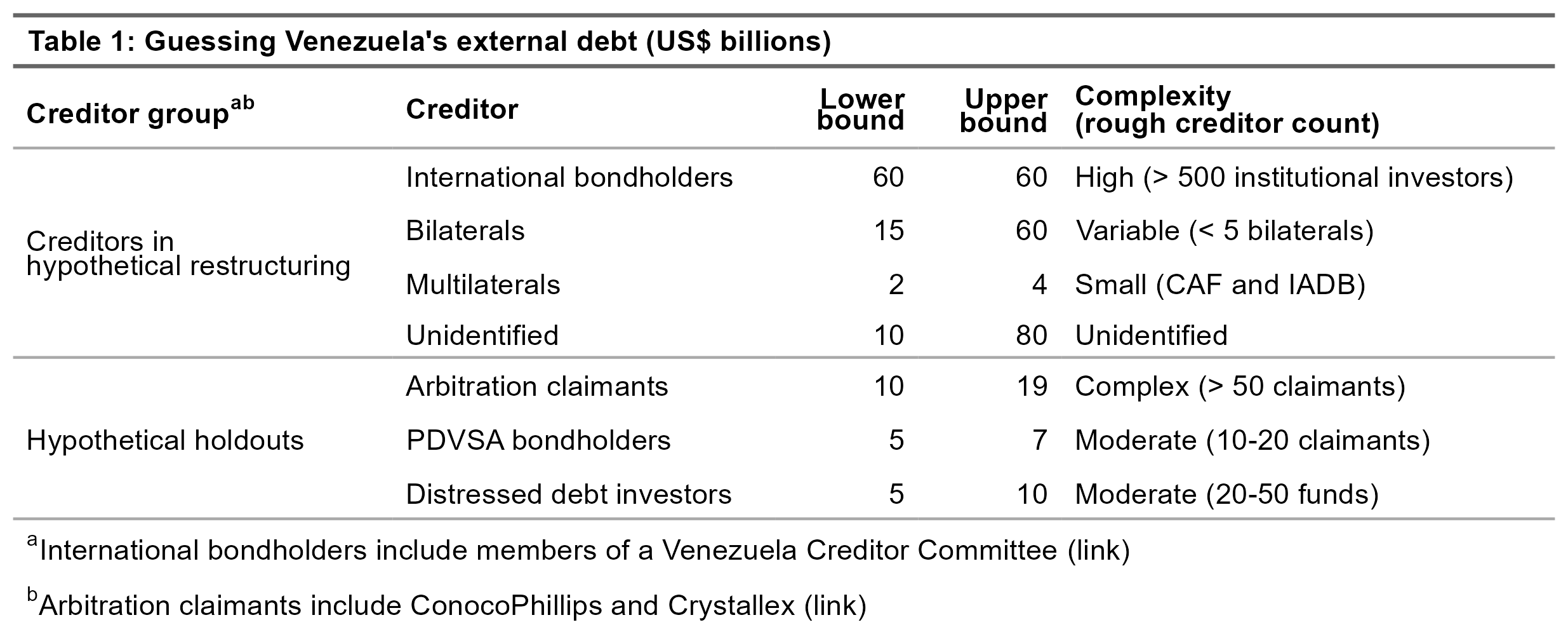
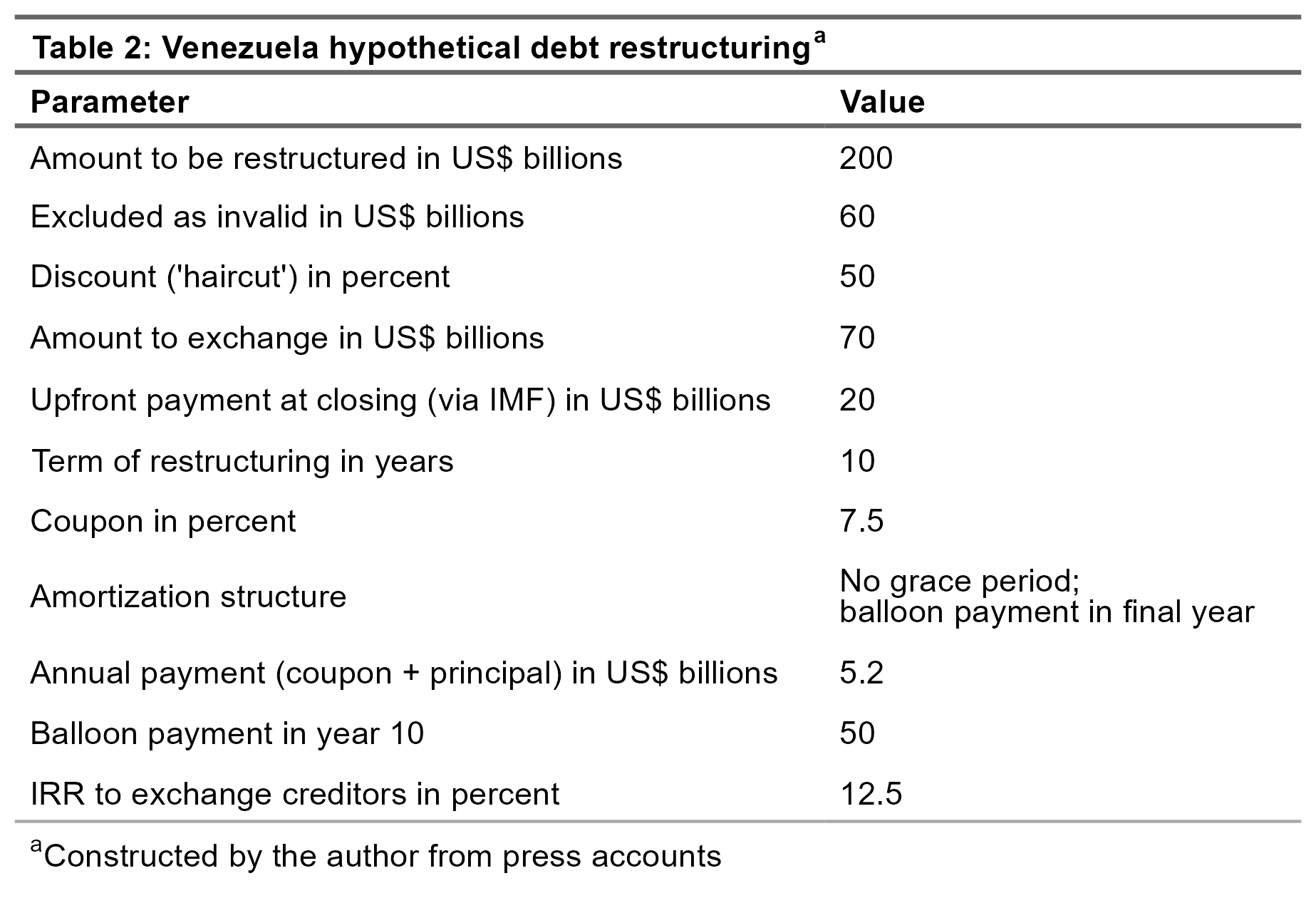
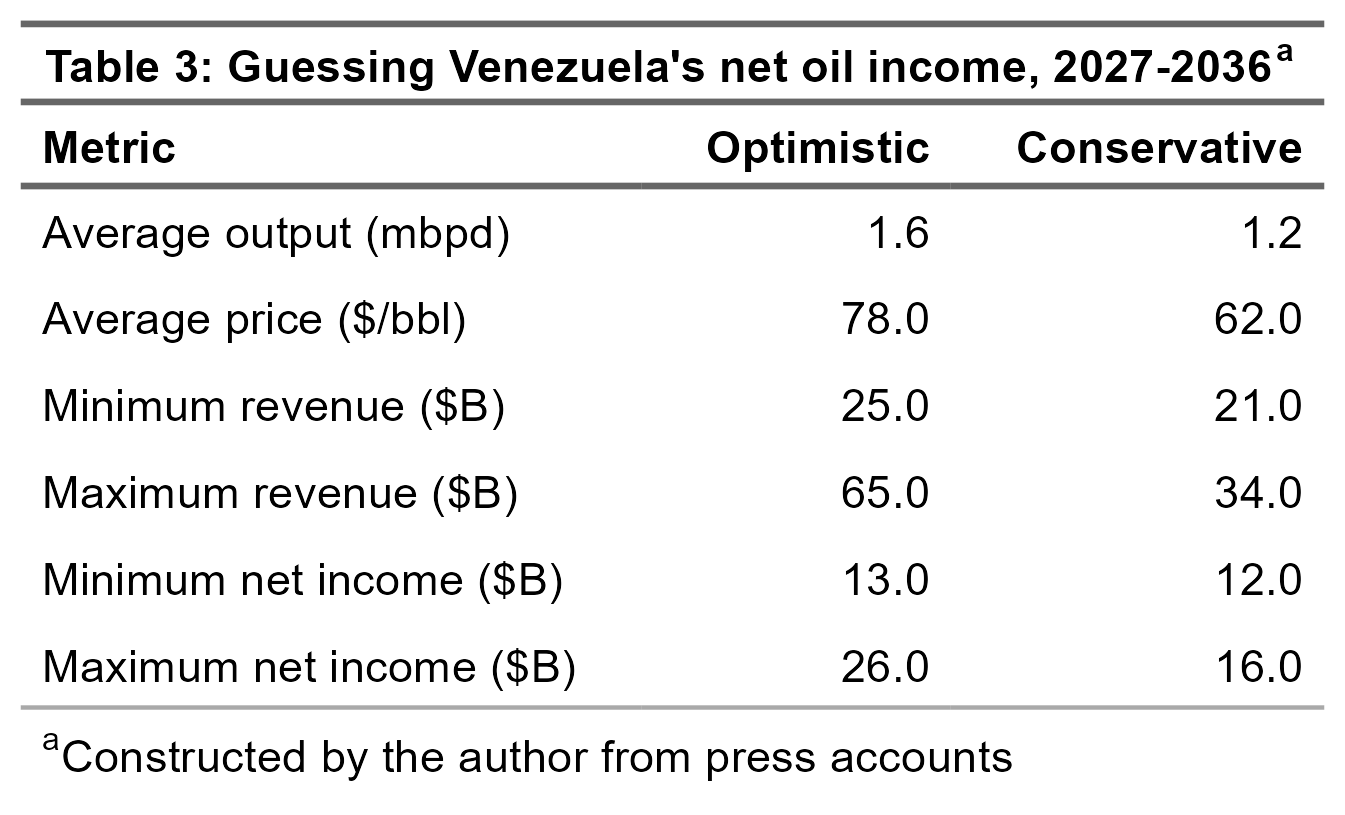
Figure 1: Oil income vs. debt service (US$ billions)
Source: Author’s calculations.
Note: Debt service does not include obligations to multilateral development banks.
Source: Author’s calculations.
Note: Debt service does not include obligations to multilateral development banks.
1 Examples include: Steven T. Kargman, link; the Venezuela Restructuring Desk, link; Jose Ignacio Hernandez G., on the legal implications of a limited restructuring announced by the government in May: link; and several pieces in the FT in the final week of June.
2 I declare no interest or conflict in anything to do with Venezuela and have not communicated with anyone currently working in the World Bank or the in IMF on Venezuelan issues.
3 The magisterial work of Parminder Brar at mdbreform.com on the failure of much of the Bank’s portfolio, especially in Africa; the Bank’s internal review of its research [An Evaluation of World Bank Research 1998-2005]; and the 2025 Learning in World Bank Lending is a comprehensive criticism of the “knowledge Bank” fad that began under Jim Wolfensohn in the 1990s; there have even been recent accusations of job-buying within senior management of the Bank.
4 Parminder Brar, at mdbreform.com, has reported Nigeria’s misuse of COVID emergency resources from the IMF.
5 Carlos Tablante reviews efforts to find Venezuelan assets held abroad, in “La proteccion de los activos de Venezuela en el exterior en esta nueva etapa”, CuentasClarasDigital.org, March 10, 2026.
6 The Bank and the Fund should forbid direct or indirect public guarantees to oil and gas investors as program conditions.
7 A potential obstacle is that the holdouts (those chasing the US$36 billion) might demand a share of the Fund’s upfront payment. I understand private litigants do not have standing to attach Fund payments to sovereigns against whom binding judgments have been rendered.
8 One must not exaggerate—this is a deal among tyrants of three decades, the IMF, the oil satrapies, and a grasp of contingency fee wranglers.
9 Venezuela has hired a US firm to assist with an audit of its foreign assets and the operations of its central bank.
10 The exchange bond holders will demand cash up-front and where else are they going to get it but from the IMF?
11 Gillian Tett in the FT also raises the alarm on this.
12 The Fund is not omniscient. The institution has not shown un excès de zèle in following off-the-books oil sales by the Central African petrostates; note also the revelation that Nigeria had as much as 2% of hidden public spending despite the supposed monitoring of the Fund.
13 Political risk guarantees of physical assets would, however, be a possibility.
14 Schlegel and Olmeda, “Potential and limits to a democratization from below in Venezuela”, Centre for Constitutional Change, February 2026.