What do the IMF and the World Bank owe Senegal ?
There are exceptions to the rule that “Un mauvais arrangement vaut mieux qu’un bon procès »
Senegal’s financial troubles have not acquired the notoriety of those of Argentina, Egypt, or Pakistan and of the many other debt-encrusted regimes*,[1] but they do reveal the costs of easy money to the preterite. Easy money generates covert loans, contingent guarantees, corrupt acquisitions,[2] and inflated costs. The revelation of secret deals may eventually ruin the borrower, making it more expensive to borrow and, more importantly, imposing cuts in public spending so that obligations to lenders may be honored, or at least to those lenders who know where the line forms.
Sovereign illiquidity is commonly followed by noisy appeals to the IMF and the World Bank for cash—in the lingua franca of the Fund, this would be something like“short-term finance to fill an unexpected financing gap in a sustainable manner over the medium term while maintaining essential public services to the poor”. When the short-term money dries up, the global organizations are then asked to support resolution of sovereign debt and guarantees to private lenders.[3] Such restructurings have, as I wrote recently on Argentina,[4] the chief purpose of rescuing lenders from their own folly, not that of protecting public services from usurers. A second purpose of debt restructurings is to delay legal or administrative sanctions, thereby confusing the public while allowing the complicit to keep their fortunes and to avoid prison.
This post describes Senegal’s recent case of lying to the IMF, known in that institution’s antiseptic chambers as “misreporting”. The case is that the Senegalese government in power until April 2, 2024[5] had been fabricating data about public spending and debt management to the Fund and to the multilateral development banks (MDBs*) since about 2019. While the press has reviewed much[6] of what is known publicly, I focus here on interpreting available information to highlight the delinquency of the Fund and the Bank at all levels and to suggest actions that would benefit Senegal including corrective measures by both institutions.
The long crisis of Senegal[7]
The long crisis of Senegal is that it should be a middle-income country in 2026 and it is not. It has many advantages--good location (a port close to Europe and the US; rail access to the interior Sahel), talented people (as shown by the many Senegalese professionals in international organizations and in Western Europe[8] and the US), abundant labor from low-wage neighbors, rich export potential (cereals, oilseeds, fish, livestock, phosphates, music, fashion, tourism, financial services, logistics), generally free trade with West and Central Africa within a currency union, and, at independence in 1960, reasonably strong national unity and equitable income distribution.
Senegal’s economy lags its potential and its human development indices are not what they could be. One reason is that the country is more committed to a certain restricted vision of prosperity than it is to prosperity itself. Because its leaders prefer to speak of development rather than to promote it [9], Senegal has underinvested in education, health, and nutrition and [10] productive infrastructure (roads, rails, ports, urban mobility, power, water and sanitation, logistics). A second cause is French imperialism which has imprisoned Senegal in the franc zone, where the CFA franc (CFAF) is chronically overvalued, imposing a tax on exports and a subsidy on imports from France. Beyond their self-interested manipulation of the CFAF exchange rate, les cousins blancs* have grabbed much of infrastructure and finance, captured the economic outlook of the national elite, and excluded from its colonial interests economic partnerships those outsiders who might provide better, cheaper services. A third cause is corruption whereby the Senegalese often put their characteristic intelligence, charm, and débrouillardise* to producing private goods in preference to public while generally avoiding accountability beyond the primary school admonition to “never do that again”.
The immediate crisis
“Organic markets, carefully styled “black” by the professionals, spring up everywhere.“ - Pynchon
The immediate crisis of Senegal is debt that it cannot pay. The country’s usual move in this (recurring) situation has been to seek help from the IMF and the World Bank. While the Fund is always guided by the famously disinterested and wise counsel of the French nationals who serve the global commons as senior managers in the Fund, the Bank has at times been forced to accept threats from Bercy* about IDA* replenishment, the recapitalization of IBRD*, or the HIPC* trust fund to make it see the light.[11] Another source of assistance is the Paris Club*, a group of 22 bilateral creditors that takes orders from Bercy meets collegially to review debt relief petitions from LICs*. After the regime* of former President Macky Sall was[12] found, belatedly, in February 2025, to have lied to its citizens and to its external creditors about its indebtedness[13], the usual channel of assistance from the IMF has been blocked and will apparently remain so until the government and les freres ennemis* can craft a suitable cover story.
Such a story is proving difficult to write at the Fund, for reasons explained in what follows. I continue with: (1) a description of the 2021 IMF program, known as a “stand-by arrangement”* (SBA*); (2) a discussion of the Fund program reviews held during 2021; (3) the new Fund program and a World Bank budget support operation in 2023; (4) the belated 2025 revelation of off-budget borrowing and spending over the years 2020-2024; and (5) what should be done to impose some accountability in Senegal and in Washington.
The 2021 IMF program
The Fund approved a loan in the amount of 453 million SDR (about US$650 million or 350 billion CFAF*) in June, 2021.[14] The loan’s purpose was to “permit the Senegalese authorities … to face an actual but short-term balance of payment need [in order to] support the authorities’ crisis [COVID] response, promote a broad-based recovery, catalyze additional concessional financing, and strengthen the external position of the WAEMU”*. The Fund’s contribution to filling Senegal’s financing gap was about 41% of the 2021 gap; another 20 percent came from co-financiers’ budget support and the DSSI*.
Fund staff, in presenting the 2021 operation to their Board, insisted on its short-term nature and argued that the package would add little to external indebtedness. Staff projected that the stock of external public debt, in percent of GDP, would rise modestly from 52.8 in 2019 to 56.6 in 2022 while the service of external debt, in percent of government revenue, would rise from 22.1 in 2019 to 26.1 in 2025. The report argued that COVID had added to the country’s external debt; the reader will note that Senegal’s external debt stock, in percent of GDP, had risen well before COVID, from about 23 in 2010 to about 52 at end-2019, with an additional increase of only 2-3 percentage points from end-2019 to end-2020.
The Fund mission chief made the usual somnambulant remarks about program integrity:
“As part of the Fund supported program, the authorities have engaged an audit firm to conduct an audit to assess whether the recording and communication of data on public debt (including the debt of the SOE* sector) is accurate, exhaustive and in line with best practices. This should help improve the quality and timeliness of the data available to the authorities for planning and debt management purposes. Following some administrative delays, the audit is expected to be completed in the first half of 2021.” [and]
“The inclusion of para-public enterprises and SOEs began in 2017. The list of entities covered by the DSA* is provided in the Technical Memorandum of Understanding. The 2018 public sector balance sheet was compiled with support from Fund TA. Previous DSAs erroneously indicated that the social security system was not covered by the debt perimeter.”
The 2021 SBA submission also argued that Senegal’s debt to the Fund would be manageable. Staff projected the stock of obligations to the Fund to be 3.1 percent of GDP at end-2023, falling to 1.5 percent of GDP at end-2025. Repayments to the IMF would be 0.1 percent of government revenue in 2021 (0.5 percent of external debt service), rising to 3.7 percent in 2025 (17.5 percent of external debt service). The Fund’s official view in mid-2021 was that “Senegal’s debt is projected to remain sustainable with a moderate risk of external and overall public debt distress (see Debt Sustainability Analysis).” The IMF held this opinion despite Senegal having off-budget borrowing of at least 15 % of GDP to end-2021, of which Fund staff should have known.
In sum, the IMF claimed in June 2021 that it and Senegal’s partners (notably the World Bank, whch was party to the DSA) had complete information on Senegal’s external debt. Staff claimed repayment risks to the Fund were manageable.
The SBA Reviews in 2022
The Fund concluded two reviews of the SBA in 2022. The first (IMF Country Report 22/8 of January 2022) concluded that the country “economic prospects remained good” but warned that “Fiscal space is rapidly shrinking. The debt stock and debt service burden have increased steadily over the last decade. Senegal’s risk of debt distress continues to be assessed as moderate but with little margin to absorb shocks.” . The review reported that an audit of the debt database had not identified major weaknesses, though staff advised that the “… risks to debt sustainability [must] be carefully monitored” including those arising from the timeliness and reliability of SOE debt data.
The second review (June 7, 2022) concluded:
“Senegal is assessed to be at moderate risk of external and overall public debt distress, with limited space to absorb shocks. Public debt is projected to commence a downward trajectory in 2023 … “ with the usual Fund folderol about how “Maintaining debt sustainability in this context requires a prudent borrowing strategy that prioritizes concessional external borrowing and domestic regional financing alongside continued efforts to strengthen debt management.”
Comparing the second review to the first and to the request for an SBA in 2021 (Country Report 21/127) shows some erosion in Senegal’s fiscal and external balances with respect to Fund projections at the time of program approval (Table 1 in the Appendix).
The 2023 WB and Fund budget support programs
In the fourth quarter of the 2023 Bank-Fund fiscal year[15] (FY23), the Bank approved US$300 million in an IDA Credit* to Senegal for a “Second Equitable and Resilient Recovery Development Policy Financing” (Bank Report No: PGD388, May 16, 2023). The Bank’s macro projections in May 2023 are as shown in Table 2 in the Appendix; they would have been closely aligned, if not exactly equal to, those of the Fund prepared in June 2022 (or the Fund would have squeaked about it across 19th Street). The Bank’s Program Appraisal Document referred to the June 2022 DSA, which concluded that “public debt remains at moderate risk of external and overall debt distress, with limited scope to absorb shocks.” The Bank concluded that “The macroeconomic policy framework is adequate for the proposed operation.” These Panglossian remarks appeared in mid-2022, a year which ended with the Republic of Senegal having borrowed almost 19 percent of GDP off budget without anyone noticing.
Signs of trouble in the Senegalese accounts, at least as far as the freres ennemis* would admit publicly, came with the new Fund program approved in June 2023. This intervention involved US$1.834 billion in loans, comprised of an Extended Fund Facility (EFF*) in an amount of US$1.007 billion, an Extended Credit Facility (ECF*) in an amount of US$503 million, and an RSF* of US$324 million (in total, 4.5% of GDP). The Fund made an immediate disbursement of US $216 million (about 2.7 % of government revenue). Fund management assured its Board that the program would support, inter alia, “ … a growth-friendly fiscal consolidation strategy aimed at safeguarding debt sustainability, strengthening governance [while supporting] the country’s climate change mitigation and adaptation strategy”. The need for a new program of 4.5% of GDP, on top of the outstanding stock of debt to the IMF of 2.4% of GDP, was unexplained by Fund staff.
I make two observations on the sequence of the Bank and Fund programs in 2023. There is no honest reason for the Bank to provide budget support of nearly 4.5% of 2023 government revenue in advance of the largest Fund commitment in Senegal’s history unless the intention is to fill a financing gap that Bank and the Fund would not yet admit to their shareholders.[16] The second aspect of the unusual sequence (Bank, then Fund; instead of Fund, then Bank) is covert support to the Sall regime which, in May and June of 2023, planned to stay in power indefinitely in defiance of certain annoying provisions of the Senegalese constitution. Support for Senegal’s erratic finances, tarted up as an investment in regional stability[17] and tied with green ribbons for “equity” and “resilience”, is just the sort of threadbare deal that Africa regional management in the Bank would have pitched to Ajay Banga in his first quarter as WB President.
The 2023 Fund program document insisted more than once that public financial management would improve, which is to be expected after the injection of 7.5% of government revenue in one quarter. The Fund asserted that “The government is committed to improving financial reporting and public accountability by … Strengthening the reporting system for the main extrabudgetary entities and including them within the scope of the government’s financial operations. In addition to the TOFE* of the central government, the TOFE of the general government will be produced and published no later than October 30 of the fiscal year.” The Technical Memorandum of Understanding (TMU*) restated the usual requirements about timely reporting of the debt of the central government and of parastatal enterprises.
The Fund held the first review of the EFF/ECF/RSF (Fund Report 23/435) in December 2023. The Fund team[18] stated that the Government’s capacity to repay the IMF was “adequate” and the country’s risk of debt distress was “moderate”. The review mentioned “overfinancing”* for the first time—the fact that government’s actual borrowing in 2023 exceeded its projected borrowing needs. Fund staff accepted the authorities’ fairy tale about the overfinancing:
“[The government of Senegal] is raising an amount [of debt] equivalent to approximately 3.2 percent of GDP, including through syndicated commercial loans from international banks and issuance on the regional financial market (Text table 3 [in the Fund document]). The amount of over-financing is calibrated to cover debt service payments during January-April 2024. Staff concurred with the overfinancing strategy, which effectively represents a financing shift between 2023 and 2024, and therefore constitutes a debt management operation with no material impact on the debt level or the DSA.”
Fund Report 23/435 having concluded in a mood of “Todos contentos y yo tambien”, Fund staff have seen no need for further analysis of the Senegal program in the ensuing two years. Nor has the IMF issued any public statements about the country apart from vague press releases and self-congratulatory answers to questions from the press.
The Bank has approved several new investment operations but has not prepared further budget support operations in Senegal since the development policy financing of May 2023.
The 2024/25 report of the Senegalese Cour des Comptes*
The campaign for the Presidency of Senegal ended with the inauguration of Bassirou Diomaye Faye on April 2, 2024. In accordance with Senegalese law, the Faye government commissioned an audit by the national Cour des Comptes of that government’s report “sur la situation des finances publiques” covering the period from 2019 through 31 March 2024. Senegalese law required the situation report to be completed within three months following each new presidential term; the Cour des Comptes received the situation report on 18 September 2024. The audit was completed and eventually made public in February 2025.[19]
The Cour des Comptes audit found:
· Notable errors in debt amortization schedules, debt stocks, and bank balances related to public debt;
· Significant overfinancing (taking on more new public debt than was needed to meet deficit financing targets in the years 2019-23);
· Aberrant management practices affecting government cash flow, notably repeated misattribution of government revenue from one fiscal year to the previous fiscal year;
· Defects in the management of government term deposits;
· Failure to return the balance of a sukuk* instrument in 2022 to the Treasury;
· Incomplete accounting of public debt;
· Significant off-budget bank debt;
· Budget deficits greater than those shown in official accounts; and
· Stock of public debt greater than those given in official accounts.
The recommendations of the Cour des Comptes are given in more detail in the Annex (“Audit du rapport sur la situation des finances publiques—Gestion de 2019 au 31 mars 2024”). A summary is:
· Regularize revenue reporting and tax data;
· Bring off-budget spending and special Treasury accounts on‑budget;
· Reconcile external financing data and strengthen debt recording;
· Correct banking data and manage term deposits transparently;
· Transfer all remaining sukuk SOGEPA* proceeds to the Treasury;
· Produce a comprehensive, accurate record of guaranteed and bank debt;
· Correct and restate fiscal deficits and public debt levels; and
· Strengthen internal controls, transparency and legal compliance.
The findings permit speculation about possible sanctions against those involved, in or out of the Senegalese government and administration, but there is no public information about such sanctions.
The Fund[20] announced on August 26, 2025, that an international audit firm had completed a “comprehensive [debt] reconciliation exercise”—which is of course not available to the public—and that in consequence “the [Senegalese] authorities have revised the stock of central government debt from 74.4 percent to 111.0 percent of GDP at end-2023. This revision primarily reflects previously undisclosed liabilities. At end-2024, the revised debt statistics show central government debt reached 118.8 percent of GDP.” The revision to 111.0 percent of GDP at end-2023 compares to the value of 100 percent estimated by the Cour des Comptes for end-2023.
What is to be done ?
There must be a comprehensive approach to creating some integrity of Senegal’s public finances. I suggest these steps: (1) admitting that Senegal cannot pay its foreign debts—stop the idle talk about “illiquidity” and recognize that the country is insolvent; (2) confessing that previous public finance “reforms”, financed for decades by the Bank and the Fand, have failed grossly[21]; (3) restructuring foreign debt, including obligations to the Bank, the Fund, and to private lenders to achieve a significant reduction in the present value (PV*) of foreign debt; (4) accounting for the fiscal cost of the guarantees signed by the Sall regime in its final year;[22] (5) admitting the responsibility of the Fund and the Bank in the country’s insolvency, notably in those institutions having made imprudent loans in 2023 to support the government budget as part of an effort to save a corrupt government from the voters; (6) investigating public officials and private agents to determine their criminal or civil responsibility in Senegal’s insolvency; and (7) investigating Fund and Bank officials using the respective procedures of those institutions.
In Senegal
There should be criminal investigations[23] of everyone involved in the debt and guarantee rackets, including of any private agents who may have been involved in works financed with off-budget debt or guarantees, or as recipients of subsidies. It is doubtful that such investigations are underway or we would have heard about them. What is most likely is that they are being covered up in the expectation that the public will forget them while the Fund and the Bank devise a cover story to calm their shareholders (at least the few among them who have any sense of outrage).
Second, the government should abrogate those debts and guarantees for which it is not legally responsible.
Third, the government should restructure the loan guarantees found by the Cour des Comptes which had somehow been forgotten in the reports of the Ministry of Economy (Ministère de l’Economie, du Plan et de la Coopération; MEPC*) and of the Ministry of Finance and Budget (Ministère des Finances et du Budget; MFB*). One possibility is to cancel the guarantees for projects which had not reached financial closure at end-2025.
Senegal should, at last, do more than talk about budget transparency and publish its complete and detailed accounts from this century.
In the Fund and the Bank
Fund and Bank management will whine that neither could have detected the fabrications before September 2024. This excuse is neither credible nor relevant. It is not credible because the evidence was visible as construction projects, notably the Maison des Nations Unies, and in cash moving through the local banking system and the BCEAO*. The excuse is not relevant because it is the job of the Fund and Bank to know these things before the public does; with the exorbitant privilege of preferred creditor status comes the responsibility to do a better job.
The joint failure of the Fund and the Bank in Senegal should oblige those lenders to take a haircut*.
The IMF must:
· recognize its culpability in the insolvency of Senegal and make corresponding reductions in that country’s obligations with the goal of reducing the PV of Senegal’s debt service to the Fund by least 20 percent;[24]
· cancel the undisbursed balances of the EFF/ECF/RSF;
· rebate all fees and charges paid by Senegal to the IMF since 2019;
· re-schedule repayments of the disbursed commitments to Senegal over a longer amortization period; and
· conduct a public inquiry into the activities of Fund staff working on Senegal since 2018, including those in the management of Africa Department and in the office of the Fund MD, including previous Deputy MDs who were responsible for management oversight on lending to Senegal.
The World Bank must:
· Recognize its culpability in Senegal’s insolvency;
· Reduce the NPV of the country’s debt service to IDA by converting much of the recent IDA portfolio to full grant terms;
· Stop budget support operations to Senegal, given that such projects rarely produce the advertised benefits and given that, in 2023, the IDA operation ““Second Equitable and Resilient Recovery Development Policy Financing” (US$300 million) was used to finance repayments to the IMF;
· Conduct a public inquiry into Bank staff working on budget support operations and on debt sustainability issues in Senegal since 2018 and more broadly into those in the Bank’s Africa Region Vice-Presidency with management responsibility for overseeing budget support operations; such people either knew of the illicit debt and guarantees or should have known; and
· Begin an Inspection Panel investigation into the Bank’s “Second Equitable and Resilient Recovery Development Policy Financing”, where regional management, despite the involvement of some 40 staff, failed to respect Bank safeguards.
The French Treasury
The French, given their historical role in the economy of Senegal and in the Fund [25], should propose that the Paris Club cancel all of Senegal’s official bilateral debts.
Glossary
Arrangement IMF jargon for loan
BCEAO Banque Centrale des Etats de l ’Afrique Occidentale; the central bank of Senegal and seven other nations
Bercy Metonym for the French Ministry of the Economy and Finance
Cent mètres carrés A prison in Dakar
CFAF African franc; the currency of Senegal
Charges and fees IMF jargon for monies paid by borrowers to the IMF for the privilege of regular endoscopies
Completion point The date on which a country’s debt relief was declared to be “definitive” under the HIPC Initiative
Cour des Comptes The national audit office of Senegal
Débrouillardise Ingenuity does not quite get it
DSA Debt sustainability analysis
DSSI Debt service sustainability initiative
EFF/ECF Extended Fund Facility/Extended Credit Facility
Exercise French for fiscal year; The fiscal year of Senegal is from January 1 to December 31
Feuilleton Serialized fiction often seen in newspapers
Haircut A reduction in loan repayments, often achieved by reducing principal or by extending maturity and, in some cases, resulting in a reduction in the present value of the loan
HIPC Highly-indebted poor country (initiative)
IBRD International Bank for Reconstruction Development
IDA International Development Association
IDA Credit World Bank jargon for discount loan to low-income countries
Illiquidity A brief embarrassment of a debtor to its creditors
Insolvency An extended embarrassment of a creditor to its shareholders about the quality of its assets
Le pre-carré Historically, French domestic fortifications against invaders; recently, the French zone of influence; members of the community of French-speaking nations
Les cousins blancs the French
Les freres ennemis the IMF and the World Bank
LICs Low-income countries
MDBs Multilateral development banks
MEPC Ministère de l’Economie, du Plan et de la Coopération du Senegal
MFB Ministère des Finances et du Budget du Senegal
MICs Middle-income countries
Misreporting IMF jargon, meaning lying to the Fund; generally, without consequences
Overfinancing IMF jargon, meaning constitution of a slush fund
PPPs Public-private partnerships; a way of separating the public from its money
PV Present value of a cash flow
Paris Club https://clubdeparis.org/en/communications/page/how-do-we-work
Regime French expression implying the de facto union of an “administration” (career civil service) and “gouvernement” (elected officials and appointees); in English, “regime” connotes authoritarian rule
Repurchase IMF jargon meaning repayment of a loan
Resilience The capacity of a system (biological, for example) to return to its trend condition following an external shock; in the Bank and the Fund, jargon meaningful generally only at Davos
RSF Resilience and Sustainability Facility of the IMF
SBA Stand-by arrangement
SDR Special drawing rights (the IMF’s unit of account)
Slippage Failure to meet the Fund’s unrealistic program targets
SOE State-owned enterprises; sometimes known as parastatals
SOGEPA Société de Gestion et d’Exploitation du Patrimoine de l’État; a Senegalese parastatal managing government real estate
Sukuk A form of finance compliant with Islamic law
TMU Technical Memorandum of Understanding; the annex to Fund program documents explaining what the borrower must do under the program
TOFE Tableau d’opérations financières de l’état; a one-page summary of a government’s annual flows of revenue, expenditure, and financing items; the latter including loans and grants)
Usine à gaz Talk shop; useless meeting
WAEMU West African Economic and Monetary Union
Annex
Notes on the report of the Cour des Comptes, “AUDIT DU RAPPORT SUR LA SITUATION DES FINANCES PUBLIQUES GESTIONS DE 2019 AU 31 MARS 2024”
Findings
The main findings of the Cour des Comptes are a revision of the budget deficit for 2019-2023, considering the off-budget spending not included in the TOFE (Table A1, derived from Table 39 in the Cour des Comptes); and a revision of the official debt stock from 2018-2023 (Table A2, derived from Table 40 in the Cour des Comptes).
Table A1. SENEGAL: Review of budget deficit, 2019-2023 (billions CFAF)
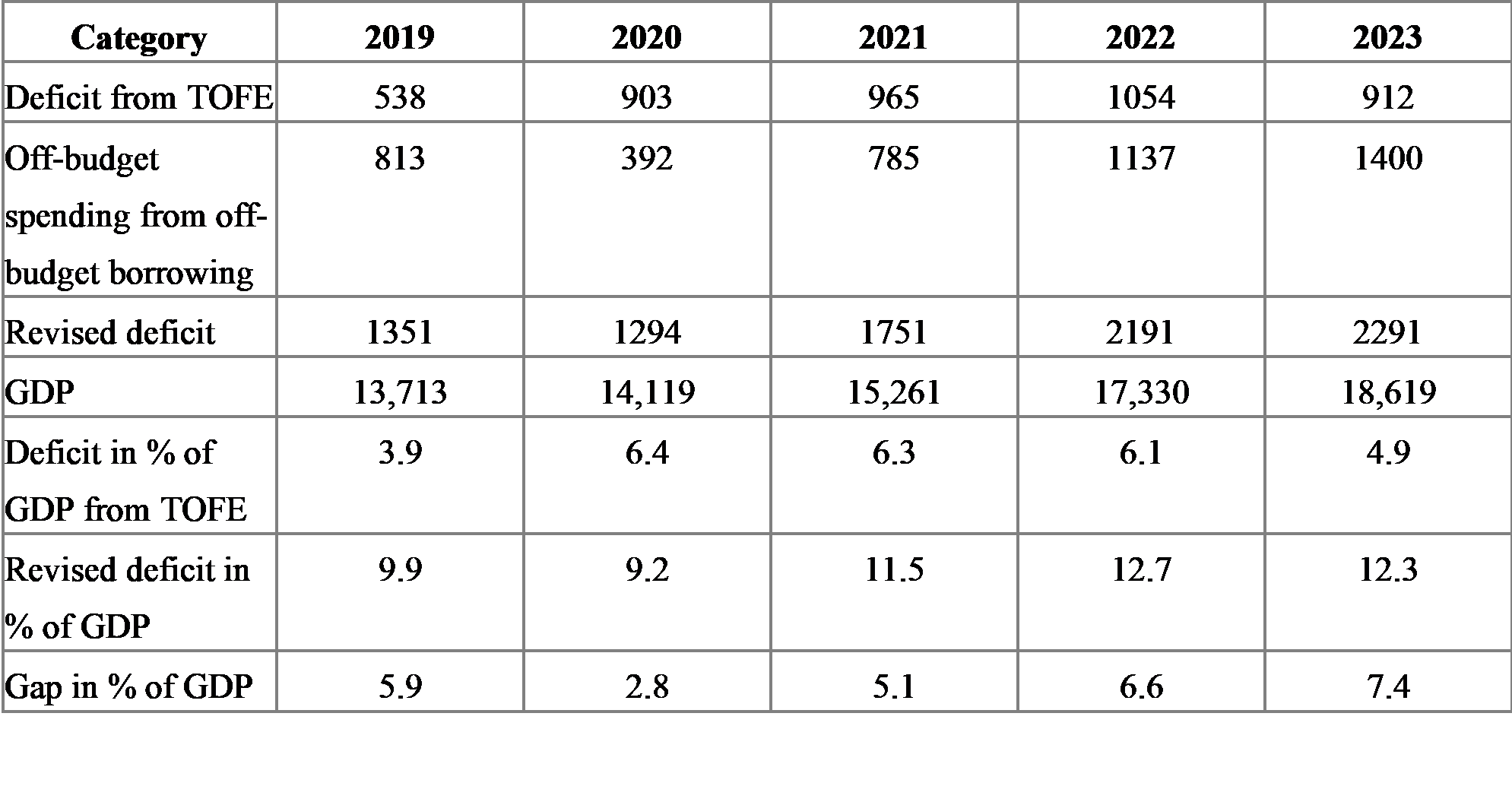
Source: Cour des Comptes, Table 39, p. 43
Table A2. SENEGAL: Stock of public debt, 2019-2023 (billions CFAF)
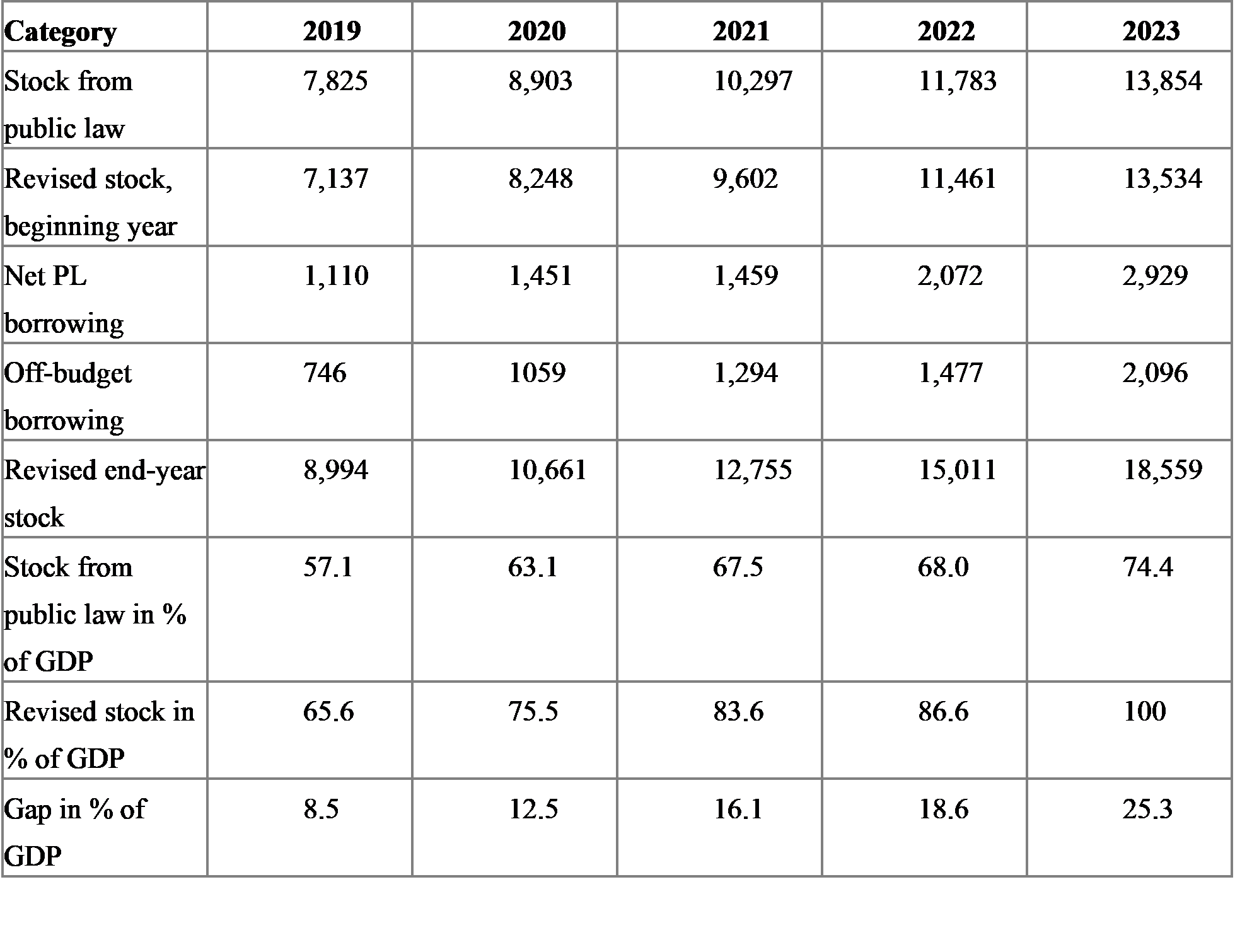
Source: Cour des Comptes, Table 40, p. 44.
The report of the Cour des Comptes has nine conclusions and eight recommendations[26].
Conclusion
The Cour des Comptes found:
• notable errors in the debt amortization schedules, the debt stocks, and the bank balances related to public debt;
• Overfinancing (that is, taking on more new public than was needed to meet deficit financing targets in the years 2019-23) was significant;
• improper cash management practices;
• defects in the management of government term deposits;
• that balance of a sukuk* instrument in 2022 was not returned to the Treasury;
• an incomplete accounting of public debt;
• significant off-budget bank debt;
• budget deficits were greater than those shown in official accounts; and
• a stock of public debt greater than that shown in official accounts.
Recommendations
The report’s eight recommendations are framed as commitments that the government “shall undertake to” do something.
1. Regularize revenue reporting and tax data
The government undertakes to stop irregular revenue reclassifications, to produce an exhaustive, reconciled statement of tax arrears, and to compile a complete, documented inventory of tax expenditures. This means aligning revenue data across administrations, clearly recording all outstanding tax debts, and systematically identifying and costing every exemption and relief measure.
2. Bring SNPE spending and special Treasury accounts back on‑budget
The government undertakes to limit and strictly regulate transfers to services non personnalisés de l’État (SNPE) and Treasury special accounts like CAP/Gouvernement and PDIES, and to integrate these flows into the normal budgetary and accounting framework. In practice, this requires capping such transfers, defining their legal basis and purpose, and ensuring they are fully reflected in budget laws and year‑end accounts.
3. Reconcile external financing data and strengthen debt recording
The government undertakes to harmonize all external financing data among the Debt Directorate (DDP), the spending‑authorization directorate (DODP) and the TOFE, eliminating inconsistencies in disbursement and amortization figures. The recommendation implies setting up robust reconciliation procedures, shared databases, and clear responsibilities so that project loans, drawings and repayments are recorded identically everywhere.
4. Correct banking data and manage term deposits transparently
The government undertakes to reconcile Treasury balances with commercial‑bank statements, to regularize all term deposits (depots à terme) and to ensure that any remaining deposits are fully and promptly returned to the Treasury. This includes identifying DAT still sitting in banks, recovering the funds, and prohibiting their use as informal collateral or off‑budget liquidity instruments.
5. Transfer all remaining Sukuk SOGEPA proceeds to the Treasury
The government undertakes to transfer to the Treasury the outstanding balance (about CFAF 114.4 billion) from the 2022 SOGEPA Sukuk that was not paid into the Treasury account. It must also clarify the legal and financial arrangements governing this bond (the sukuk) so that all proceeds and uses are transparently recorded in State accounts.
6. Produce a comprehensive, accurate record of guaranteed and bank debt
The government undertakes to establish an exhaustive inventory of State‑guaranteed debt and of all bank borrowing contracted off‑budget (including direct credits, CNOs and substitutions of debtor), and to integrate these into the official debt statistics. The recommendation also calls for stopping new off‑budget borrowing and subjecting any guarantees or bank loans to prior budgetary and parliamentary control.
7. Correct and restate fiscal deficits and public debt levels
The government undertakes to revise and restate the fiscal deficit and public‑debt figures presented in budget‑execution documents and laws of settlement so that they reflect all previously omitted operations. This involves adjusting past years’ accounts, updating the TOFE and related reports, and presenting corrected deficit and debt paths to Parliament and the public.
8. Strengthen internal controls, transparency and legal compliance
The government undertakes to reinforce internal control mechanisms, comply strictly with the organic budget law and the Code of Transparency, and ensure that any practices causing extra‑budgetary spending or unauthorized use of public funds are halted and sanctioned. Concretely, this means tightening procedures in the Ministry of Finance and the Treasury, improving audit trails, and systematically following up on Court of Accounts findings.
[1]. Expressions marked with ‘*’ are defined in the Glossary. I thank reviewers for comments on earlier drafts.
[2]. In 2002 or so, Abdoulaye Wade (President of Senegal, 2000-2012) called Jim Wolfensohn (President of the World Bank, 1995-2005) at home to discuss Wade’s 44 pages of comments —Wade was a French-trained lawyer, après tout--on Senegal’s draft law governing public-private partnerships (PPPs*). Wade’s remarks were ultimately reduced to a single point—he wanted the law to allow “une procedure d’urgence” at the discretion of the Head of State.
[3]. Such deals invariably seek to protect the preferred creditor status of the Bank and the Fund.
[4]. https://johnmcintire.substack.com/p/milonga-triste?r=lxiat
[5]. Macky Sall was President of Senegal from 2012-24. Bassirou Diomaye Faye became President on 2 April 2024. The late Peter Doyle has written forcefully on the delinquency of the Sall regime and of the IMF apparatchiks in https://www.financialafrik.com/en/2025/10/20/imf-shame-senegal/
[6]. https://www.ecofinagency.com/finance/2910-46080-senegal-s-1-8bn-imf-program-frozen-finance-minister-confirms; https://www.afronomicslaw.org/category/african-sovereign-debt-justice-network-afsdjn/sovereign-debt-news-update-no-140-senegals; https://www.reuters.com/world/africa/senegals-government-underestimated-financial-situation-court-auditors-says-2025-02-12/
[7]. I was World Bank Country Director for Senegal, The Gambia, Guiné-Bissau and Cape Verde from September 2000 to July 2004, resident in Dakar.
[8]. A French official: “I cannot understand why I have a Senegalese doctor in France and a French doctor in Senegal.”
[9]. To illustrate: Senegal hosts the regional central bank, the BCEAO*, in an architectural masterpiece overlooking the Atlantic; the Governor of the BCEAO resides in a mansion more golden than that of the President of Senegal with a view extending to Fortaleza; yet, Senegal is unable to say just how much money it has in the BCEAO.
[10]. We have a current (December 2025) example 65 years after independence. Senegal and UNICEF are hosting yet another usine à gaz* international meeting of experts on nutrition, at a time when 15-20% of the country’s under-fives are stunted and 5-10% suffer from wasting.
[11]. The French are notorious for harassing Bank staff who interfere in the pre-carré*. After a diktat from the unfortunate Beregevoy to then-WB President Lew Preston, the Bank fired an operational Director for voicing some vague heresy about the CFAF. In this century, the erstwhile French ED in the Fund and the Bank, Ambroise Fayolle, while promoting the undeserving HIPC candidacy of Congo-Brazzaville, threatened the late Gobind Nankani, then VP of the Africa Region in the Bank, saying “Gobind, je n’amerais pas que vous ramassiez une balle perdue”. The French later did their part to make good on the threat to Nankani who was defenestrated in the fall of 2006 after some nasty machinations among war criminal Paul Wolfowitz and various member countries of the Bank.
[12]. Sall is now the unofficial French candidate to become the next Secretary-General of the United Nations, in case anyone thinks it is possible to be too cynical about anything.
[13]. The February 2025 report of the Senegalese national auditor (la Cour des Comptes) https://www.courdescomptes.sn/wp-content/uploads/2025/02/Rapport-de%CC%81finitif-sur-la-situation-des-finances-exercice-2019-au-31-mars-2024.pdf.
[14]. IMF Country Report 21/127. Quotes and other material cited in the section “2021” are from Country Report 21/127 unless otherwise noted.
[15]. The Bank Fund fiscal year (FY)* runs from July 1 to June 30. The 2023 FY was therefore July 1, 2022, to June 30, 2023.
[16]. Part of the saga here is that the MD of the Fund, Kristalina Georgieva (Bulgaria) anxious to win a second term in late 2024, would have pitched the Bank assistance to Ajay Banga, freshly arrived as President of the WB, as part of her effort to maintain French support for her second term.
[17]. The Senegalese opposition party had made ominous noises about abandoning the CFA franc during the election campaign, but those noises have subsided.
[18]. The error here cannot be blamed on a change of mission chief who was the same in December 2023 as in June 2023 (Edward Gemayel, Lebanon). Nor can the Bank’s laxity in the second half of 2023 be blamed on an immediate change in Country Director (Keiko Miwa, Japan, arrived in Dakar in July 2023).
[19]. The Cour des Comptes audit omits the obvious fact that significant off-budget borrowing and spending would have been difficult without the knowledge of the BCEAO.
[20]. https://www.imf.org/en/news/articles/2025/08/26/pr25282-senegal-imf-staff-concludes-visit
[21] The Cour des Comptes observes : « Malgré leur importance, les droits de douane ne font pas l’objet d’un suivi administratif et comptable centralisé»; there has been a customs service in Senegal since 1819.
[22]. Between April 6, 2023, and February 5, 2024, the MEPC signed guarantees of an approximate value of US$1.9 billion or some 5.4% of an estimated 2025 GDP of US$35 billion. Those guarantees were not included in the MEPC’s reporting to the Fund or the Bank.
[23] The Cour des Comptes notes the option of reference for criminal prosecution: “Les faits relatés dans le présent rapport, présumés constitutifs de fautes de gestion, de gestions de fait ou d’infractions à caractère pénal feront l’objet, le cas échéant, de déférés, de référés ou de déclarations provisoires de gestion de fait. »
[24]. A simple model of these reductions is attached as Tables 3 and 4 in the Appendix.
[25]. A Fund mission chief, returning to Washington from West Africa, stopped in Paris to brief his esteemed colleagues at Bercy. Upon his subsequent arrival in Washington, the mission chief was summoned by Michel Camdessus, then the MD of the Fund and formerly Directeur du Trésor Français, who demanded to know why his subordinate had debriefed the French before debriefing his own management. Answer : “Mais, Monsieur le Directeur General, lorsque vous étiez au Trésor, c’est vous qui aviez insisté à être débriefé par toutes les missions du FMI avant même leur retour à Washington.”
[26]. https://www.courdescomptes.sn/wp-content/uploads/2025/02/Rapport-de%CC%81finitif-sur-la-situation-des-finances-exercice-2019-au-31-mars-2024.pdf