Why is the IMF hiding its failure in Argentina ?
The Washington Post’s economic views have tended to follow neoliberal orthodoxy in the manner of Goldilocks, seeking a center that would attract serious readers without greatly disturbing the ignorance of the less serious ones. In the case of Argentina a 2018 editorial warned that country might be in “deep economic trouble” and raised questions about a new global crisis. The Post sagely advised the US and the IMF to stabilize Argentina rather than let it default on its foreign debt, in an effort to avoid poverty and instability throughout Latin America. A 2019 article noted that former President Macri’s reforms had failed to stop inflation and intoned gravely about a revanchist Peronism. An eventual 2020 debt restructuring, assisted by the IMF, gave limited relief to the country which continued along its path of inflation, weak investment (public and private), lagging employment, and poverty1.
The Post’s opinion pages have become more assertive in their admiration of the latest Argentine caudillo and now lean to what I call “techno-Randism”. A January 2026 column covered Javier Milei at Davos, praising his attack on “socialism” and pointing to faster growth in 2025. The paper has lately published (Washington Post, April 3, 2026) a triumphant editorial—“New data from Argentina shows the real answer to poverty”—in which it assures its few remaining readers that Argentina has found the answer. The Post described Milei (elected President of Argentina in December 2023) as a “new Trump” emerging from the wrecks of high inflation, deep poverty, and one responsive to public demands for radical free-market policies. The Post now presents Argentina, after Milei’s 27 months in power, no longer as the rented mule of its avaricious creditors, but as proof that “capitalism leads to prosperity” and that such policies as deregulation and cuts in the public work force will allow markets to work and to sustain growth and poverty reduction.
This Substack, following my earlier pieces on Argentina, seeks to validate the Post’s claims about the effects of economic reforms, compares them to historical changes in poverty rates and other macro variables, and concludes with some thoughts about why the Post published this editorial when it did. My argument is that the Post’s views are hardly more substantial than the cartoon figure of Jacques Delors, during the 1982 recession, which showed Delors raising a torch before him while proclaiming that he “saw glimmers of a recovery.”
What does the Post claim ?
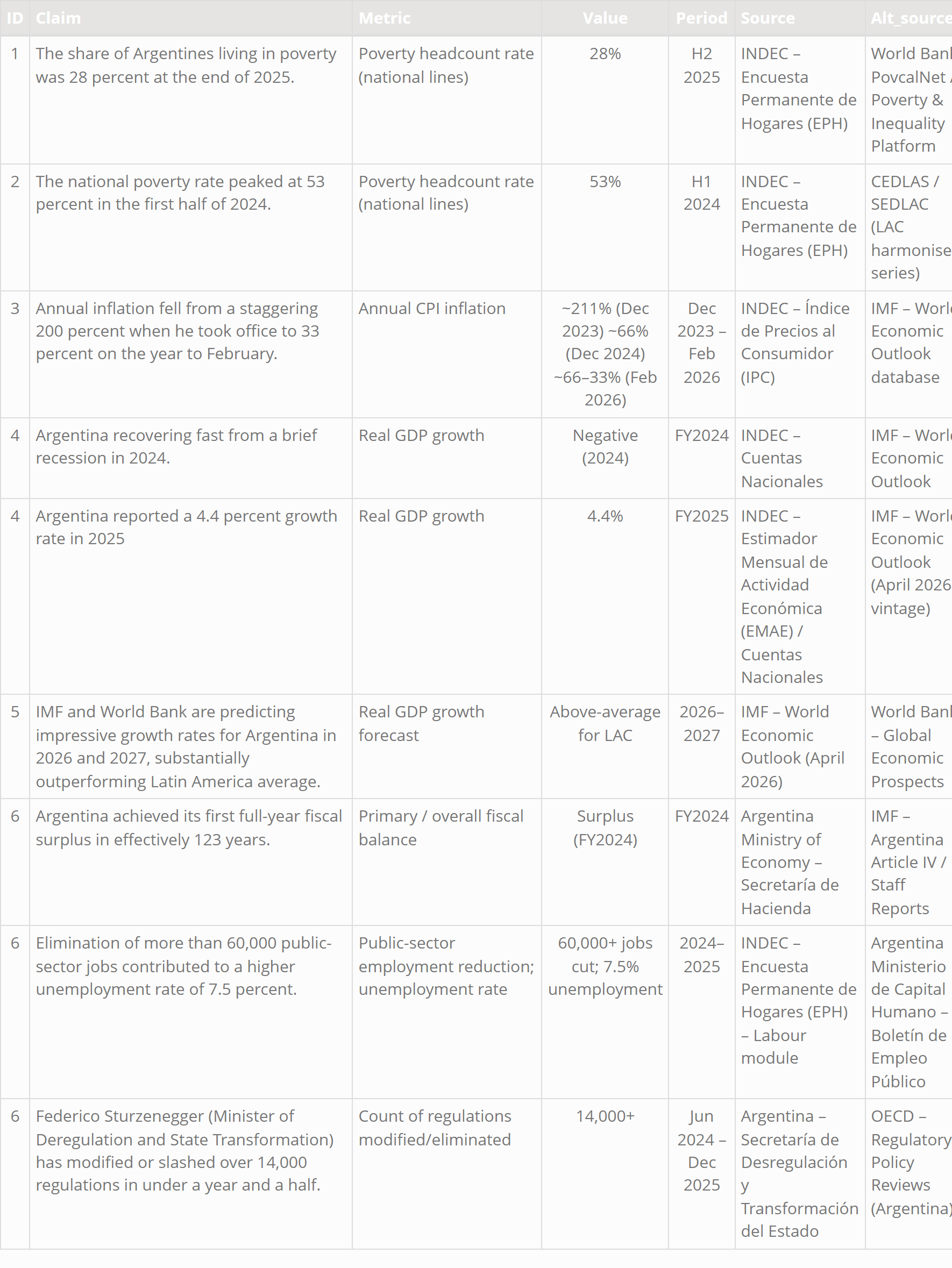
Table 1 describes the Post’s specific claims about Milei’s record. The Data Annex gives more details.
The Post notes (Claims 1 and 2) “The share of Argentines living in poverty was 28 percent at the end of 2025” representing a “dramatic decline in poverty rate” which had “peaked at 53 percent in the first half of 2024.” The contention that the poverty rate fell sharply from mid-2024 to end-2025 is a legitimate re-statement of data collected and analyzed by the Instituto Nacional de Estadística y Censos (INDEC). Claims 1 and 2 are valid but as we shall see below the survey data and analysis must be reviewed carefully.
The contention (Claim 3) that inflation fell from triple digits to the range of 30–40% is valid for the period 2023–2025. INDEC found that annual inflation had fallen from 211 percent in 2023 to a 12-month year-on-year value of 33 percent in February 2026 (https://www.indec.gob.ar/uploads/informesdeprensa/ipc_03_2650E16DA2A9.pdf).
Claim 4 is valid-–the Argentine economy was in recession in 2024 and recovered in 2025. Argentina reported a 4.4 percent growth rate in 2025, compared to −1.9 percent in 2023 and to −1.3 percent in 2024.
Claim 5 is valid at least formally–-the IMF and the World Bank did project “impressive growth rates” for Argentina in 2026 and 2027. The substance of the claim is unverifiable in that it cannot be checked until at least 2028.
Claim 6–-that Milei has slashed public jobs and pushed deregulation–-is valid. Milei’s Minister of Deregulation and State Transformation reports having modified or repealed 15,144 public regulations from December 2023 to February 2026 (https://www.argentina.gob.ar/desregulacion). Argentina did, moreover, achieve a primary surplus in FY2024 for the first time in the 21st century.
Evaluating the claims
The Post’s recitation of facts is generally accurate. The paper nonetheless fails to interpret those facts with much insight––it does not identify a path by which policies act on growth, it exaggerates policy effects, and ignores information that is incompatible with its promotion of Milei’s cult of personality.
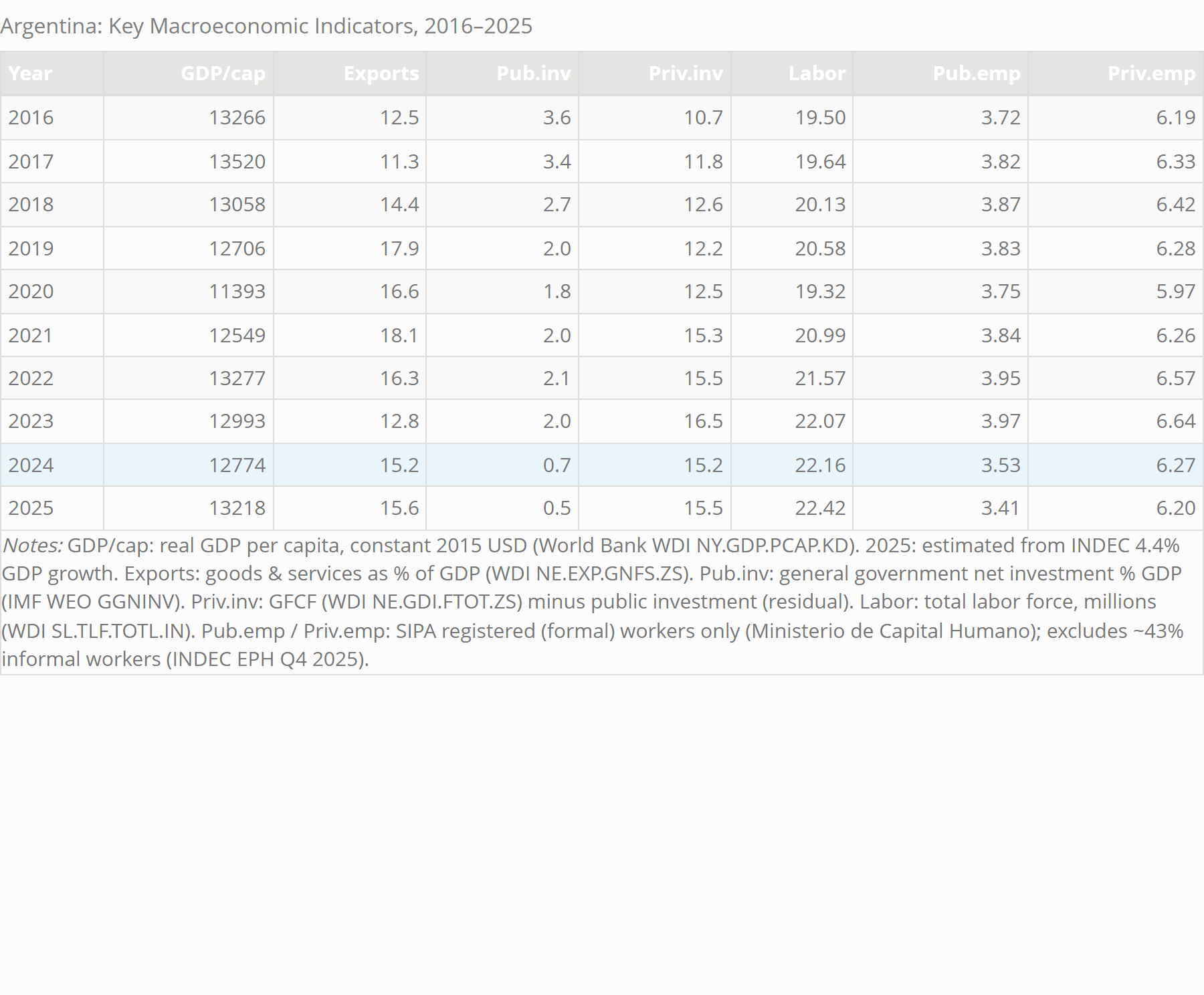
The Post’s conclusion that the “bet (by Milei on market-oriented policies) has paid off” is unjustified. The implication that Milei’s policies have restored growth and price stability past 2025 is unproven. One year (2025) of recovery is not a trend. Argentina’s average GDP per capita for 2023-25 was about 2 % percent less than in 2016-2018 (Data Annex, “Some macroeconomic indicators, 2016-25”). Appeals to the authority of the Fund’s projections for Argentina are unconvincing–an IMF review has found (“An Analysis of the Forecasting Performance of the World Economic Outlook,” IMF Working Paper WP/21/216, November 2018) that the Fund’s growth projections for Latin America have often been inaccurate. More specifically, the Fund’s ex-ante projections on Argentina, made as part of its 2018 program there, were overestimates of ex-post growth and underestimates on ex-post unemployment, inflation, and the stock of public debt (IMF Country Report No. 21/279, “Argentina: Ex-post evaluation of exceptional access under the 2018 stand-by arrangement—press release and staff report”).
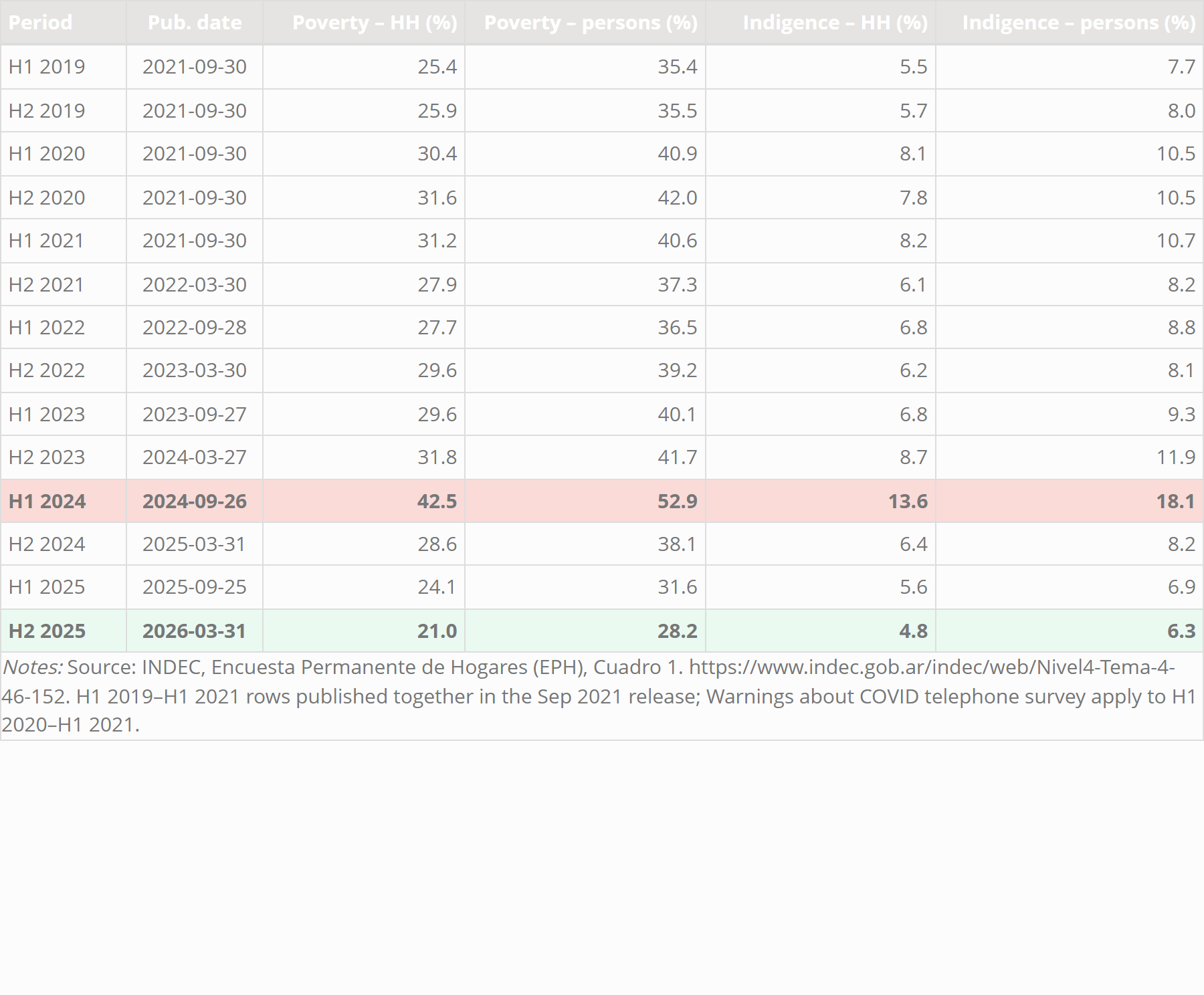
The Post’s arguments about poverty in Argentina are superficial. Poverty remains scandalously high, notably among children (Data Annex, “INDEC EPH poverty and indigence rates, H1 2019–H2 2025”). There is evidence that changes in survey methods have generated part of the officially-reported reduction in poverty. An Argentine research institute (https://www.eco.unlpam.edu.ar/wp-content/uploads/2025/12/Informe-Pobreza.pdf) analyzed the decline of 21 percentage points (pp) from H1 2024 to H2 2025 (the headline change) and found that: (a) real income gains (the true measure) were 13–16 pp of the 21 pp; (b) failure to update the cost of basic foods (the Canasta Basica Total, a measurement problem), about 4 pp; and (c) improved coverage of income sources (a gap in the data) about 4 pp. A sampling practice may cause chronic underestimation of the numbers of poor people in Argentina. Places outside the 31 urban areas surveyed probably have higher rates of poverty than the surveyed areas; the excluded places may include as much as one-third of the total population. National extrapolations from the urban samples alone would therefore understate national poverty.
The Post does the usual libertarian hand-waiving about policies to promote capital formation and growth. The implicit assertion (which follows from Claim 6) that public job cuts and deregulation will promote investment and growth is untested. The Argentine record of reforms is simply a list of items, things that cannot be mapped into an investment or exports function that would explain Argentina’s modest revival of growth in 2025. Yes, the Milei regime claims there has been deregulation but no one knows what it has achieved in terms of lower costs of private production or higher returns to public investments. It is true that average gross fixed capital formation (Data Annex, “Some macroeconomic indicators, 2016-2025”) was 12.5% higher in 2023-25 than in 2026-2018 because of an increase in private investment (which is consistent with the Milei story) but the long-term effects of that increase will not be known for years and do not, in the event, justify the Post’s enthusiasm for Milei’s reforms. More troubling is what the Post does not mention–-that public and private employment fell steadily as a share of the labor force from 2016-18 to 2023-25. Employment, exports, and investment (all things that ought to have been associated with less poverty) have not grown.
The Post’s conclusion that Milei’s frenetic self-promotion somehow constitutes an effective reform program, one bearing rich lessons for others less enlightened by techno-Randism, is invalid. It picks some good things–lower inflation, less poverty–and tells a just-so story about why these things have happened. We end up with the bizarre situation in which the Washington Post has to shine a selectively filtered light on Milei’s good works (leaving aside the problem of US$5 million that has gone missing in a crypto deal) because the Fund is unable to craft a credible story about Argentina that can stand public scrutiny during the Spring Meetings.
Table 1: Quantitative claims in the Post’s editorial and in published data
The Post is promoting Milei to hide the IMF’s failure in Argentina
The IMF would ordinarily take the opportunity of the Spring Meetings of the Bank and the Fund to brag about the successes of its largest borrower——lower inflation, some restoration of capacity to pay its debt, better growth in 2025, and a more stable nominal exchange rate since the fall of 2025. It seems, however, that the disorder in the national statistics agency, the opacity in the management of the Central Bank, the heavy debt service expected in 2026, and Milei’s (alleged) crypto dealings have all dimmed the light that Kristalina Georgieva and Dan Katz would customarily waive before the eyes of their audiences at this time of year.
The IMF and the Bank cannot be too openly enthusiastic about Milei because there will be questions about the second review of the Fund’s program and the weakness of the underlying facts. The Fund’s review, months overdue, has this week been drafted at the staff-level as noted in a misleading press release (https://www.imf.org/en/news/articles/2026/04/15/pr-26120-argentina-imf-reaches-agreement-on-2nd-rev-under-eff-arrangement). I say “misleading” because the core issue in the current IMF Program–-the level of central bank reserves–-was already modified at the first review in 2025; has not been progressing, despite the Fund’s attempt to conceal this reality by referring to “an incipient buildup in reserve buffers”, and is inflated by the Fund’s US$12 B disbursement of April, 2025.
The Fund being unusually discreet about its largest borrower (Georgieva and Comms Director Julie Kozack in a press briefing of April 15 2026 say nothing about Argentina) https://www.imf.org/en/news/articles/2026/04/15/tr-04152026-press-briefing-transcript-imf-mds-press-briefing-on-the-gpa-sms-2026), it is left to the Washington Post to discover what it calls the “real answer to poverty”. This is mnemonic of the Soviet era in which Moscow would plant an article in the foreign press and Tass would pick it up as evidence that “even the West agrees with us”.
Data annex
INDEC poverty series, H1 2019–H2 2025
Values are read from Cuadro 1 of each semi-annual INDEC EPH press release. Data coverage is 31 urban agglomerates (~62–64% of Argentina’s population). Rural areas are not included.
INDEC EPH poverty and indigence rates, H1 2019–H2 2025
INDEC EPH poverty rate and HH–per capita gap
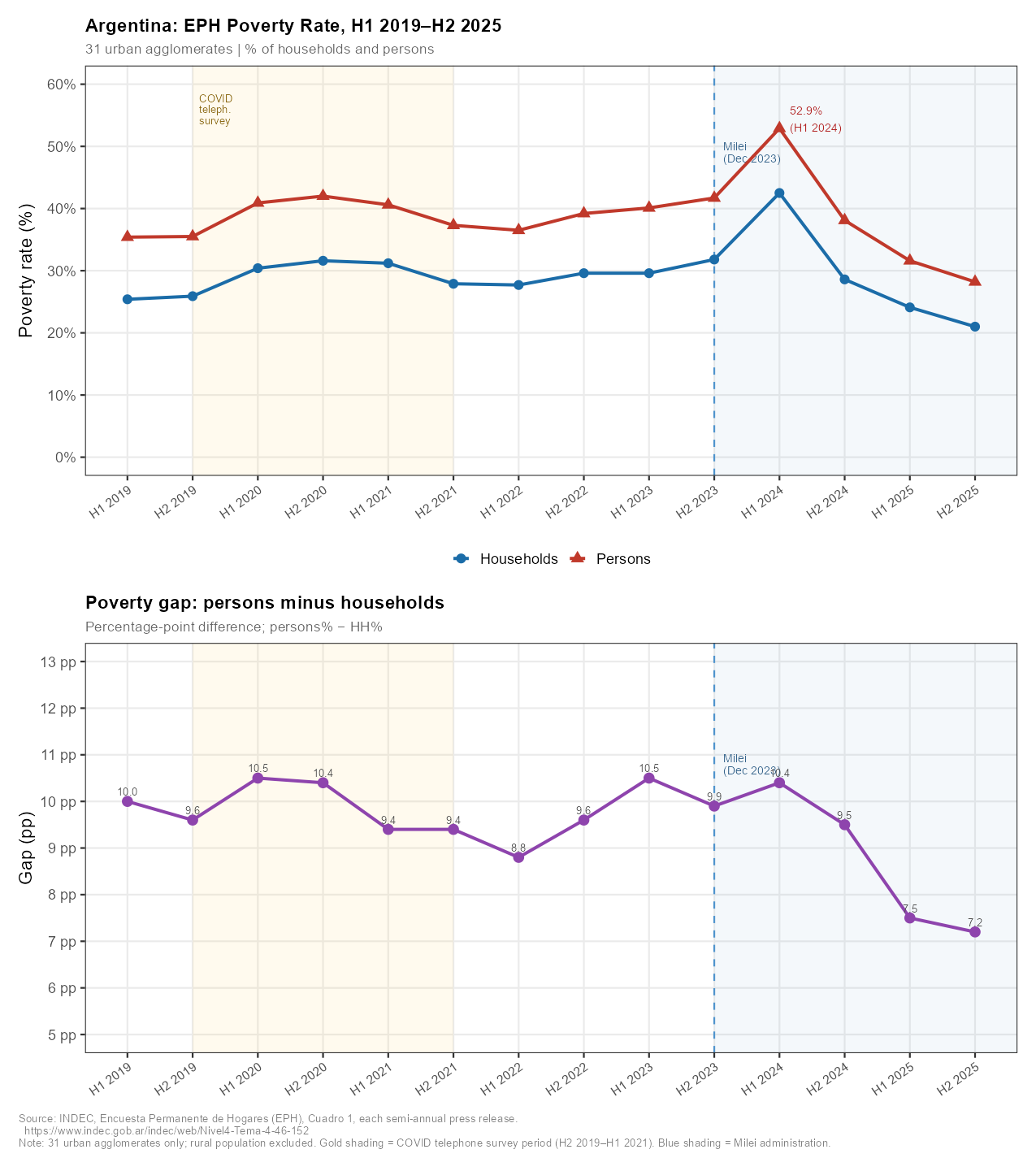
Argentina: EPH poverty rate, H1 2019–H2 2025
Some macroeconomic indicators, 2016–2025
Has the poverty line changed ?
What has stayed constant since 2016. INDEC’s poverty line is the Canasta Básica Total (CBT), which is calculated by multiplying the Canasta Básica Alimentaria (CBA — the food basket) by the inverse of the Engel coefficient. The Engel coefficient——the share of household spending on food——was fixed using the Encuesta Nacional de Gasto de los Hogares (ENGHo) 2004/05. This means the non-food multiplier is based on 20-year-old consumption patterns. INDEC updates the price level of the monthly baskets using the IPC, but the commodity composition and weights have not changed.
Food and non-food changes Argentina has seen large relative price shifts since 2004, and especially since 2023. Utility tariffs, transport, and services rose far faster than food prices during the period of Milei’s cuts in subsidies. Because the CBT formula holds the food share constant at 38.4% of total spending (the 2004/05 level), while the recent food share has fallen to 27–33% (ENGHo 2017/18 estimates), the change in the CBT is understated — meaning the poverty threshold is lower than it should be and the number of households living below that threshold is also understated.
How much is the CBT understated? A December 2025 paper from UNLPam ((https://www.eco.unlpam.edu.ar/wp-content/uploads/2025/12/Informe-Pobreza.pdf) \ estimates that updating the basket using ENGHo 2017/18 weights would raise the GBA CBT by 17–42% depending on whether restaurant spending is included. Theat study’s point estimate for H1 2025 is a poverty rate of 42% (without restaurants) to 31.4% (with restaurants) versus INDEC’s official 31.6%. The differences are larger in earlier periods. In October 2025, INDEC was reportedly studying an update of the CBA and CBT using ENGHo 2017/18, but has deferred this. Marco Lavagna resigned as INDEC director in early 2026, supposedly over disagreements over the update (https://criticasur.com.ar/nota/53086/el_indec_analiza_cambios_clave_en_la_medicion_de_pobreza_cuales_son_las_modificaciones_que_se_vienen/
Changes in definitions
No structural update to the CBT composition has occurred since 2016. This is the most significant definitional non-change. The basket has drifted further from actual consumption patterns with each passing year. CEPA estimates that the CBA now accounts for 45% of the CBT (at current relative prices), versus the 38.4% at which the Engel coefficient was set and 27% in 2016/17 — meaning the non-food component of the poverty line is understated (https://centrocepa.com.ar/informes/771-evolucion-de-la-incidencia-de-la-pobreza-y-la-indigencia-datos-al-segundo-semestre-de-2025).
EPH questionnaire changes (applied from Q4 2024). INDEC revised the EPH income module, adding 8 new questions and strengthening 5 existing ones in the non-labour income section. New questions capture Tarjeta Alimentar (food card transfers), non-contributory pensions, Progresar (education stipend program), and other social programs.
The key methodological issue: INDEC has not published any estimate of how much this change affects comparability with earlier periods. CEPA estimates that a significant share of the observed fall in poverty since late 2024 may reflect better measurement of income rather than actual income gains, based on anomalous behaviour of informal-sector wages in the EPH relative to other labour market indicators. The UNLPam paper estimates EPH income capture improvements account for roughly 4 pp of the official ~21 pp fall from the H1 2024 peak to H1 2025.
Summary of UNLPam decomposition of the official 21 pp poverty decline (H1 2024 to H1 2025): Real income improvements: ~13–16 pp; Outdated basket (understated CBT); ~4 pp Improved EPH income coverage: ~4 pp
https://www.eco.unlpam.edu.ar/wp-content/uploads/2025/12/Informe-Pobreza.pdf
Changes in sampling methods
COVID-related modifications (2020–H1 2021): The EPH suspended face-to-face interviewing during the pandemic (March 2020 onward) and shifted to telephone and online interviews. INDEC has issued technical reports noting changes in response rates, in the coverage of informal workers, and in income reporting. Results from H1 2020, H2 2020, and H1 2021 carry explicit methodological warnings in INDEC releases. By H2 2021, INDEC had substantially restored in-person fieldwork, though some transitional effects may persist in H1 2021 data.
Coverage: INDEC confirms that its figures cover urban agglomerates, not the full country. The EPH consistently covers 31 urban agglomerates representing some 62–64% of Argentina’s population. The EPH does not cover: (a) rural areas (~8% of population); (b) very small towns and (c) indigenous communities.
The definition of extreme poverty (indigencia)
Indigence is defined as households whose total income falls below the Canasta Básica Alimentaria (CBA) — the food-only basket. A household is indigent if it cannot afford minimum caloric intake even if it spent all its income on food.
The CBA is constructed from the ENGHo 1996/97 (food component), updated using the food and beverage sub-index of the IPC. It is calibrated to provide approximately 2,750 kilocalories per adult per day, consistent with FAO/WHO norms. The basket covers grains, pulses, vegetables, fruits, dairy, meat, eggs, oils, and sugar — defined by nutritional adequacy rather than observed consumption preferences.
The CBT (poverty line) is derived by multiplying the CBA by the inverse Engel coefficient (currently ~2.22, derived from ENGHo 2004/05), meaning the poverty threshold is approximately 2.2× the indigence threshold.
The indigence line has its own updating problem: although food prices are tracked monthly by the IPC, the composition of the CBA has not been revised since the 1996/97 ENGHo.
The spike in indigence to 18.1% of persons in H1 2024 (from 9.3% in H1 2023) was driven almost entirely by the December 2023 peso devaluation, which caused food prices to surge ~30% in a single month. The subsequent fall to 6.3% by H2 2025 reflects food disinflation and income recovery, not any structural change in the line.
The gap between household and person poverty rates
The percentage of persons in poverty consistently exceeds that of households by 7–10 pp.
- 2021–H2 2023: Gap is stable at 9.4–10.5 pp, suggesting a stable relationship between household size and poverty. Average household size in the EPH universe for poor households is roughly 3.4–4.1 members.
- H1 2024 spike: Both measures surge symmetrically — HH% to 42.5%, persons% to 52.9% (gap 10.4 pp). The near-symmetric shock reflects the devaluation hitting all household types, with larger households still producing a higher person-share.
- H2 2024–H2 2025 decline: The gap narrows from 9.5 pp to 7.2 pp. This is the most notable structural shift in the series. Possible explanations: proportionally stronger recovery in larger lower-income households; social transfers more effective for larger families; or EPH income capture changes disproportionately affecting lower-decile income estimates (see section 5).
The gap exists because poor households tend to be larger than non-poor households. The CBT is calculated on an adult equivalent basis. A household with four children requires more income to clear the threshold than a single-person household. Because fertility and household size are inversely correlated with income, more people per household live below the line than the household headcount alone suggests.
Child poverty is severe: INDEC reports that 54% of children aged 0–14 were poor in H1 2021. The household-per capita poverty gap narrowed from ~9–10 pp in 2021–2024 to ~7 pp in H1–H2 2025. This could reflect stronger income recovery in larger households, social transfer (Tarjeta Alimentar, AUH), or changes in how EPH measures income.
Data sources
SourceURLINDEC EPH poverty releases (all)https://www.indec.gob.ar/indec/web/Nivel4-Tema-4-46-152H2 2025 EPH press release (primary)https://www.indec.gob.ar/uploads/informesdeprensa/eph_pobreza_03_269225CA3217.pdfUNLPam poverty line methodology paper (Dec 2025)https://www.eco.unlpam.edu.ar/wp-content/uploads/2025/12/Informe-Pobreza.pdfCEPA analysis: H2 2025 EPH & methodology critiquehttps://centrocepa.com.ar/informes/771-evolucion-de-la-incidencia-de-la-pobreza-y-la-indigencia-datos-al-segundo-semestre-de-2025INDEC basket update announcement (Oct 2025)https://criticasur.com.ar/nota/53086/el_indec_analiza_cambios_clave_en_la_medicion_de_pobreza_cuales_son_las_modificaciones_que_se_vienen/World Bank poverty traps paper (Argentina)https://documents1.worldbank.org/curated/en/099103024144524874/pdf/P17545411ae34d0ab1a81a17f00b1279191.pdfCEPA methodology critique (Milei INDEC changes)https://www.enteratenoticias.com.ar/actualidad/cuestionan-cambios-del-indec-bajo-milei-impacto-en-inflacion-pobreza-y-actividad/
Software: R 4.5.2 and knitr 1.51.
INDEC data from: https://www.indec.gob.ar/indec/web/Nivel4-Tema-4-46-152
One of the virtues of Gregory Makoff’s magisterial “Default: The $100 billion court battle over Argentina’s debt restructuring” is showing how money is green in red and blue parties alike. ↩